"From Darkness We Draw Light", in: Franca Bruera and Barbara Meazzi (eds.) Plurilingualism and Avant-Gardes, Peter Lang, 2011, p. 17-28.
This article, first published in 2011, gave rise to a communication already featured in this section: See Black Light
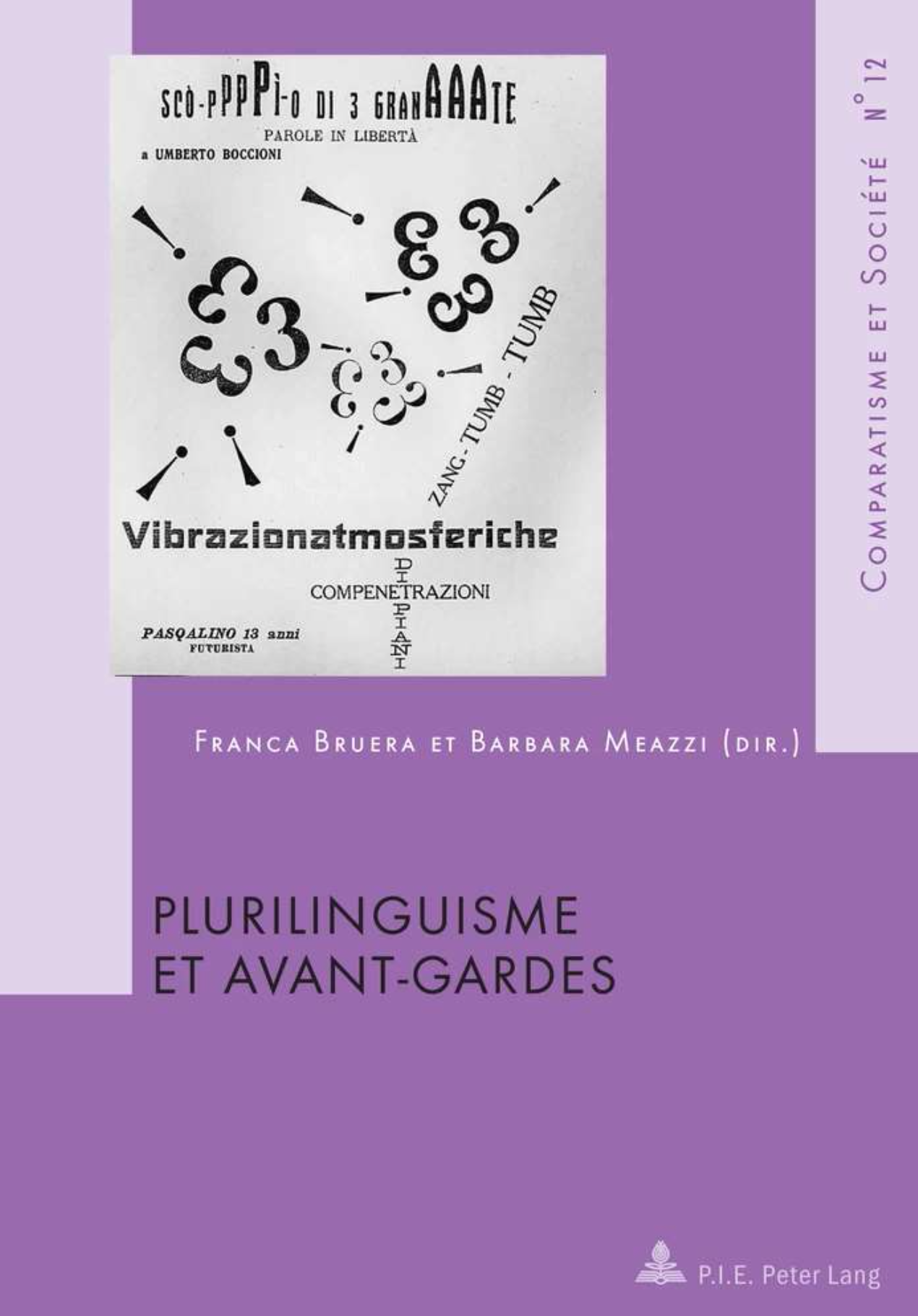
Plurilingualism and Avant-Gardes
by Franca Bruera (Volume Editor) Barbara Meazzi (Volume Editor) ©2011 Collections 536 p.
Summary
During the first decades of the 20th century, literary and artistic horizons expanded well beyond the geographical and cultural borders of Europe. Artists and writers in search of new forms of expression would give birth to different avant-garde movements conceived, among other things, as veritable laboratories of linguistic experimentation. Plurilingualism as an inexhaustible source of creation, dialectical movement and sounding board of the ontological crisis of language which claims, from 1913, "polyglottism", is one of the main characteristics of these avant-gardes. This work brings together contributions that deepen the question of plurilingualism in arts and letters, overflowing from the framework of babelization. Indeed, if in the Tower of Babel understanding was arduous and complex, in the space of plurilingualism the "Towers of Babel changed into bridges" (to take up Apollinaire's words, emblematic figure of this work) will give rise to a fertile confusion of languages and tongues.
Romance Studies Series: Comparatism and Society, Volume 12
Table of Contents
Make your languages crack: plurilingualism and avant-gardes ............ 11 Franca Bruera and Barbara Meazzi
PART ONE: LANGUAGE TANGLE
From Darkness We Draw Light (17)
Henri Béhar
Plurilingualism as cultural passport, France and Italy between transnational mobility, intellectual nomadism and linguistic flânerie (29)
Franca Bruera
The abstract poem. Inversion or precipitate of plurilingualism? (43) Antoine Chareyre
Plurilingualism as paradigm of modernity in avant-garde literature (65)
Tania Collani
The (n)on of the poetic image. Plural voices/ways of Pierre Reverdy (79)
Franck Dalmas
The openings to plurilingualism in Calligrammes (93)
Claude Debon
Poetry and unknown words. Iliazd's anthology (1919-1930-1949) (105)
Isabelle Krzywkowski
Apollinaire and the speaking calligram (121)
Anna Saint-Léger Lucas Avanguardie e lingue iberiche nella prima metà del Novecento (129)
Stefania Stefanelli
PART TWO: EXCESS OF LANGUAGES Automatism and consciousness in the avant-gardes.
The illustrations of Tzara's L'Antitête by Picasso in 1933
and by Ernst, Tanguy and Miró in 1949 (141)
Claude Bommertz
Kazimir Malevič's pen (151)
Nadia Caprioglio
Protocols of futurist experimentation of new expressive fields. The Marinettian manifesto
"The dynamic and synoptic declamation" and the manifesto
"The musical declamation" by Emilio M Dolfi (157)
Matteo D'Ambrosio
The political options of futurism and dadaism through their graphic and typographic productions (177)
Emilia David
The revolution of language in two futurists. Valentine de Saint-Point (1875-1953) and Benedetta Cappa Marinetti (1897-1977) (205)
Cathy Margaillan
Gherasim Luca, Franco-Romanian poet (227)
Ion Pop Torsions, contaminations, contacts.
The plural voice of the surrealist creator Giovanna (239)
Laura Santone
Plurilingualism and figures of innovation in Nikos Engonopoulos's poetic universe (251)
Maria Spiridopoulou
What language does the cine-eye of The Man with the Camera (1928) speak? (269)
Pascal Vacher
The Avanguardie: Joyce and futurism (279)
Carla Vaglio Marengo
PART THREE: PLURAL IDENTITIES
Wyndham Lewis
Kermesse and popular culture
of the "Danse des Apaches" (301)
Giulia Gorgoglione
Language as "ontological vehemence".
The avant-gardes between literature and philosophy (321)
Alberto Martinengo
Enif Robert and Marinetti. The two-voice futurist autobiography (345)
Barbara Meazzi
The influence of American popular culture on Les Mamelles de Tirésias (361)
Catherine Moore
Nicolas Calas: from one language to another or the exploded identity (373) Effie Rentzou
"Literary primitivism" at the time of modernity. Contribution to a grammar of historical avant-gardes (385) Hubert Roland
Heterogeneities of surrealist narrative (401)
Emmanuel Rubio
"Na djio pas! That is to say: no I don't say!"
Can hybridization be considered a new avant-garde? (411)
Peter Schnyder
Bilingualism, literature and avant-gardes: Maxime Alexandre. The example of a literary tearing or the impossible coexistence of two languages (421)
Cécile Wolff
PART FOUR: DISSEMINATIONS
F.T. Marinetti auto-translator or the quest for a "language of exile" (435)
Tatiana Cescutti
Alla frontiera del nuovo: Les Soirées de Paris, cultural crossroads of the avant-garde (445)
Maria Dario
Linguistic aspirations in André Breton.
From universalism and linguistic multiplicity
to the creation of surrealist dictionaries (459)
Elena Galtsova
Plurilingualism and Anglo-American modernist journals (467)
Céline Mansanti
Paul Dermée: Dada across Europe (479)
Victor Martin-Schmets
The French diffusion of futurist manifestos (489)
Serge Milan
No one language is complete. Ezra Pound and the Image (511)
Francesca Irene Sensini
transition toward Babel. A journal at the crossroads of avant-garde movements (523)
Yves Thomas
Cf: BLACK LIGHT: TRISTAN TZARA AND HIS "NEGRO POEMS" Listen: France culture "Dada are you there" (2018):
Cf. HOME › T10.30- THE MASKS IN THE HISTORY OF ART › "FROM DARKNESS WE DRAW LIGHT". DADA AND PRIMITIVISM "From Darkness We Draw Light". Dada and Primitivism BY ANTONIO DELISA on MAY 28, 2020 • date: 2020