"On the Brute and Algolism in Jarry", Romantisme, No. 17-18, 1977, pp. 185-201.
It is not common to include Jarry in a journal devoted to Romanticism. However, born in 1873, he does belong to the 19th century, and it is therefore rightly that Claude Duchet, editor-in-chief of Romantisme, asked me to treat the bourgeois according to the author of Ubu roi. I then attempted to consider Jarry's attitude toward the bourgeois character through the totality of his work, as contradictory as it may be. Hence this deliberately brutal title, naming the brute seen from the star Algol, while playing on this writer's alcoholic reputation. According to the tools measuring the consultation of our critical works, it would seem that this one was very widely browsed, as proven by its setup by Persée.
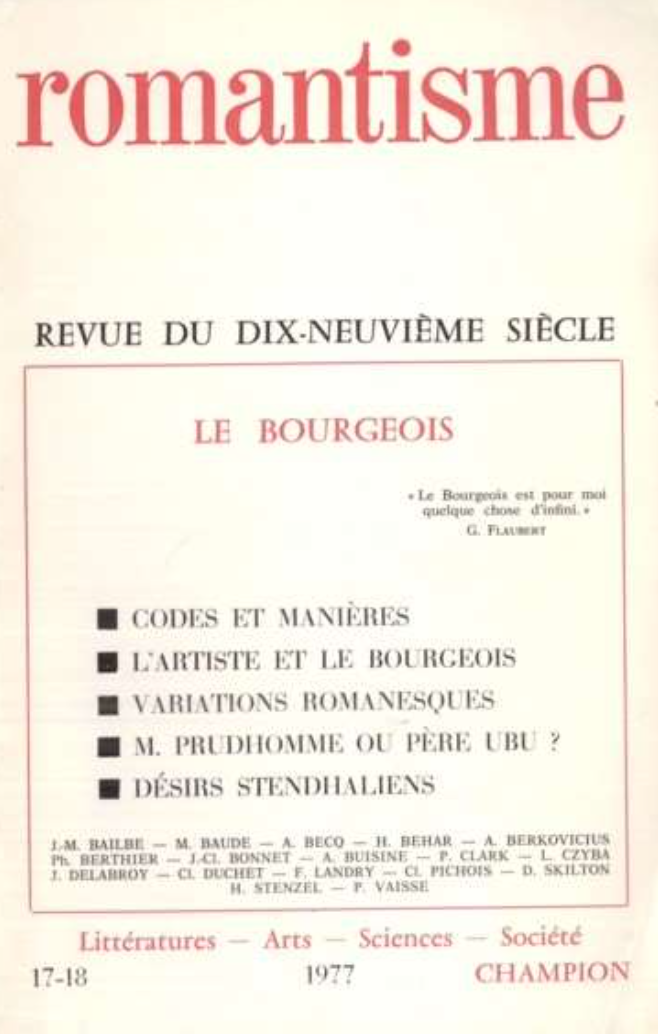
Romantisme, 1977, No.17-18. The Bourgeois.
Presentation: Of the Capital Bourgeois, Claude Duchet, 3 - 5 Talk to me about bourgeoisie (Regarding the article "Bourgeois, Bourgeoisie" from the "Dictionary of Conversation", 2nd edition, 1861), Jean Delabroy, 7 - 22 Carême or the last fires of decorative cuisine, Jean-Claude Bonnet, 23 - 43 Sociomimesis: Physiology of the petty bourgeois, Alain Buisine, 44 - 55 The journal of P.-H. Azaïs, father of family and philosopher, Michel Baude, 56 - 68 The Artist and the Bourgeois 71 - 136 Baudelaire and "the Love of Art": the dedication "To the Bourgeois" of the 1846 Salon, Annie Becq, 71 - 78 Writers and the ideological evolution of the petty bourgeoisie in the 1840s: the case of Baudelaire, Hartmut Stenzel, 79 - 91 Author strategies in the 19th century, Priscilla P. Clark, 92 - 102 Thomas Couture or the bourgeois despite himself, Pierre Vaisse, 103 - 122 The bourgeois and music in the 19th century, Joseph-Marc Bailbé, 123 - 136
From innocence to satire 139 - 201
Faces of the bourgeois in the popular novel (1800-1830), André Berkovicius, 139 - 155 Notes on the bourgeois novel of the Second Empire, Claude Pichois, 156 - 161 Taine-Graindorge and the bourgeois clichés, Lucette Czyba, 162 - 173 "Overripe beings": some narrative techniques in the presentation of the great bourgeoisie in Dickens, Trollope and Meredith, David Skilton, 174 - 184 On the brute and algolism in Jarry, Henri Béhar, 185 - 201
Two Stendhalian studies 203 - 242
The orange of Iceland: Stendhal and the myth of the North, Philippe Berthier, 203 - 227 Between nobility and bourgeoisie: "Armance" or desire without translation, François Landry, 228 - 242 Chronicle of the Society for the History of the 1848 Revolution and the 19th century revolutions, 243 - 249
Comments and critical notes 250 - 256
Mirella Larizza Lolli, II Sansimonismo (1825-1830), Un'ideologia per lo sviluppo industriale, Pubblicazioni dell'Instituto di Scienze Politiche dell'Università di Torino, Turin, Edizioni Giappichelli Torino [review] J. Valette, 250 Pierre Pierrard: 1848. The Poor, the Gospel and the Revolution [review] J. Valette, 251 Astrid Grewe: Die Literatur der Krinoline,eine historisch-soziologische Studie zum Werk von Octave Feuillet[review] 252 - 253 sem-link Cl. Foucard Bibliographic reference Dolf Oehler: Die antibourgeoise Aesthetik des jungen Baudelarie. Untersuchungen zum "Salon de 1846" [review] 253 - 255 sem-link H. Stenzel Bibliographic reference Maurice Agulhon: Le Cercle dans la France bourgeoise, 1810-1848. Étude d'une mutation de sociabilité [review], Cl. Duchet, 255 - 256
Extension: Julien Schuh, "The Relative Mysticism of Alfred Jarry": The relative mysticism of Alfred Jarry (hal.science) Read: Alfred Jarry, Complete Works, critical edition under the direction of Henri Béhar, Classiques Garnier, volumes I to VI (2012-2022): Complete Works. Volume VI (classiques-garnier.com)

Alfred Jarry in Verve, presentation and selection by H. B., Pierre Horay editions, 2003, 128 p.
What is "verve"? To define it, dictionaries, like the Grand Littré and the Petit Larousse, resort to a metaphor: "heat of imagination", they say... Happiness of expression that surprises the reader, suddenly stopped by a "word", a reflection, a retort, whose accuracy and unexpected drollery leave him delighted before the open page. Since language has existed, verve belongs only to those who are taken by the rage of words and verb. In short, all the great creators and virtuosos of language. But it doesn't appear only in printed works; some entrust it to their intimate journal, or sow it in happy formulas in conversation. The most brilliant (which are not always the most known) are gathered in this collection. HB