"On the Inversion of Signs in Ubu Enchained", Études françaises, Montreal, vol. VII, no. 1, February 1971, pp. 2-14.
I obtained my French literature degree from the University of Grenoble, for reasons it's not appropriate to revisit here. In 1960-61, I was preparing for the certificate in French grammar and philology, formidable above all others. Notably, the assistant in historical phonetics, René Gsell (1921-2000), who had been a student of André Martinet and Emile Benveniste and others at the Sorbonne, introduced us to the principles of structural linguistics, starting with Ferdinand de Saussure. So much so that, during a summer course I was teaching at the University of Montreal in 1969, when approaching Alfred Jarry's work, I had no difficulty highlighting the opposed structures of Ubu roi and Ubu enchaîné, plays that, it must be said, were perfectly ignored by French secondary or higher education. Upon my return to Paris, I organized my notes and produced this article on Ubu enchaîné. But what journal could accept it? My friend François Sullerot, eminent collector of Alfred Jarry's work, knew the editors of the journal Tel Quel, to whom he entrusted my text. Obviously, it didn't suit the reading committee, who sent it back to me three years later. And that's how I didn't make a career in French structuralism! I had no choice but to turn back to the University of Montreal, where my proposal had taken shape. I had been able to appreciate, on site, the quality of the journal Études Françaises, and especially conversed with its editors, to whom I therefore sent this small work, which they found so coherent that they placed it at the head of the issue being prepared. From this should appear shortly after my essay: Jarry, le monstre et la marionnette, Paris, Larousse, 1973, 271 p.; 17 cm, Collection Thèmes et textes.
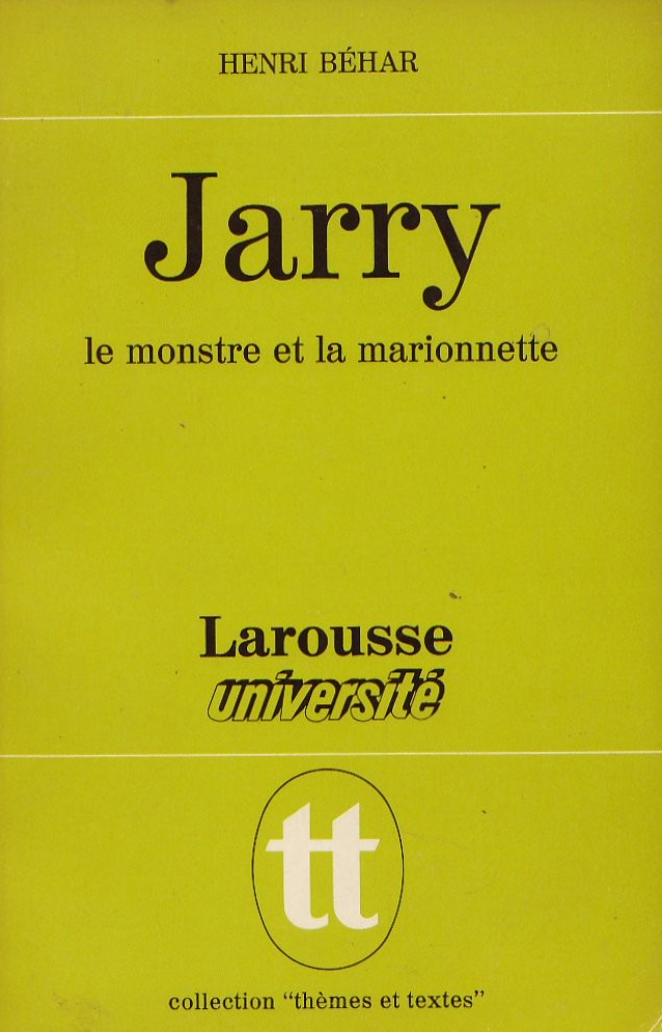
This very dense work transformed into a thesis project, so much so that it resulted in this work:
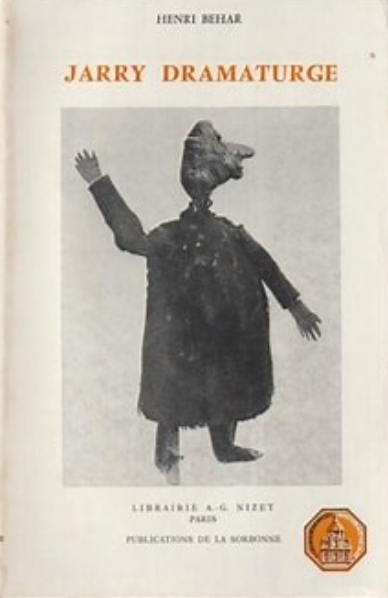
itself completed and now classic in theatrical studies:
now accessible digitally: La dramaturgie d'Alfred Jarry : Béhar, Henri : Free download, borrowing and streaming : Internet Archive.
Let's return to the beginning:
CONTENTS: On the Inversion of Signs in "Ubu enchaîné", Henri Béhar, pp. 3–21 Victor Barbeau and the regionalism quarrel, Gaston Pilotte pp. 24–48 "The silence of some ensures the rest of all", Éloi de Grandmont pp. 49–57 Notes and documents The word game, André Gervais, pp. 59–78 The void finally surpassed, H. A. Bouraoui, pp. 79–85 Chronicles The essay, Robert Vigneault, pp. 87–102 Poetry, Gilles Marcotte, pp. 103–114
Official presentation of the journal:
Founded in 1965 at the Department of French Studies at the University of Montreal (which became in 2003 the Department of French Language Literatures), Études françaises is an international journal of literary criticism and theory, whose mandate embraces the entire history and territory of French language literatures. Open to dialogues with other discourses — arts, media, history, humanities and social sciences — it often adopts interdisciplinary theoretical perspectives. The emergence, for more than thirty years, in its issues, of new problematics does not break with the humanist spirit that presided over its foundation: the valorization of the study of the literary text placed in the historical horizon of culture. Études françaises publishes three issues per year, composed of a "Dossier" that favors cutting-edge reflection around a problematic and free articles, the "Reading Exercises" that account for the diversity of current work and constitute an essential place of diffusion for emerging research. It addresses specialists in French, Quebec and Francophone literatures, and anyone interested in literature. Download the free PDF on Erudit
Digitized text of this article:
On the Inversion of Signs in Ubu Enchained
By the author's own admission, Ubu enchaîné is the "counterpart" of Ubu Roi. It is therefore appropriate to follow Jarry and examine how Ubu enchaîné opposes Ubu Roi or more precisely reverses the propositions of this drama, and how it differs from it. Taking into account that this is a theatrical play, and not simply a text, we will proceed according to a method that has become classic since the work of Jacques Schérer, that is, we will analyze its dramaturgical structure by showing what remains identical in the two works and what is affected by an opposite sign. For, as one will have guessed, Ubu enchaîné is not simply the negative of Ubu Roi (or conversely). The comparison of the two titles is significant in this regard: on the syntactic level, Ubu Roi does not oppose Ubu enchaîné but rather "Ubu slave". Jarry is so aware of this that he has his character say, in a penultimate line: "...I have nonetheless remained Ubu enchained, slave, and I will command no more" (p. 336) (1). The apposition clearly reveals the concern to correct the parallelism. But if the hero's situation is inverted, his name is not affected for all that. Now there's a good bet that Father Ubu, faithful to his patronymic, will not have changed in his essential being. Finally, one cannot forget to bring in a diachronic point of view, not because Ubu enchaîné comes, roughly, three years after Ubu Roi, nor because any theatrical writing requires a certain passage of time between the beginning of writing and the end, between the rise of the curtain and its fall, but because the antithesis necessarily comes after the affirmation of the thesis, that the "counterpart" comes after the game of the part, which Ubu himself does not fail to recall on various occasions, referring to his past misfortune in Poland. The external structure reveals a presentation identical to that of any play by Bataille or Maurice Donnay, with division into scenes and lines, role distribution, etc. One will notice an almost absolute symmetry in the formal distribution of scenes within each act of Ubu Roi and Ubu enchaîné except for the last which has four scenes in Ubu Roi and eight in Ubu enchaîné. But these calculations have little value if one does not assign each scene a coefficient representing its length and importance in the context. Let's say, to be brief, that the external structure is extremely rigorous, that it is strongly comparable to that of Ubu Roi (although the text's grooming was not perfect in the latter case, and it is attributable to Paul Fort as much as to Jarry) although the relative abundance of scenes in the last act suggests a proliferation of actions. Let's see the staging that the text imposes. The decor is not indicated by the author, no more than it was in the original edition of Ubu Roi. We will therefore assume that complete latitude is granted on this point to the future director and that Jarry would have, for his part, wished for "Ubu enchaîné" a synthetic decor, as during the performance of December 10, 1896, according to the dramatic theories he affirmed in his various writings. Let's note however a precious scenic indication: "...the Policemen and Demolishers enter. The Devout flee. The window panes and grilles are broken. The furniture is removed and replaced by straw that is moistened with a watering can. The Salon is entirely transformed into the decor of the following scene" (p. 310). This precision of Jarry shows indisputably that he envisages a change of decor integrated into the work, which is not without being original for the time, and especially that he advocates, in this particular case, a decor and accessories quite "realistic". Is this an ironic allusion to the principles of the great Antoine? It is difficult to decide the question and the discussion would make us go beyond the framework and methods we have assigned ourselves for this study. Let's signal the question by noting that it has no equivalent in the previous play. Perhaps we should see a symbol in this transformation in view: the prison would be somehow a cancer invading the stage. Like the decor, the costumes benefit from no special mention from Jarry who, on this point again would be, in case of performance, no doubt remained faithful to his dramatic conceptions, aiming at a synthetic and symbolic art. However, a character's line risks leading us very far in this direction. Pissembock declares to his niece: "I have already ingeniously required, although the custom of this free country is to go completely naked, that you be décolleté only by the feet..." (p. 280), which allows him, of course, to save on boots (2). We will not know if each character must wear a mask, if Father Ubu must don his "philosophical wool" overcoat or the "steel gray suit, always a cane stuck in the right pocket, bowler hat...", as indicated by the costume repertoire of Ubu Roi published by J.-H. Sainmont (p. 25). But to the extent that Ubu always affirms himself identical to himself, we don't see why he would present himself to us differently! It remains that Ubu slave has renounced the emblems and his royalty, which he trades for the slave's shoe kit, the slave's hook, the convict's shackles (transformation of cannon balls); the unspeakable little broom becomes slave's broom and serves for weapon handling. But the pocket remains the essential attribute of Father Ubu, as well as the green candle and, of course, the gidouille! In the list of characters, one will notice the permanence of the indissoluble couple Father Ubu-Mother Ubu, eternal as much as Philemon and Baucis, Romeo and Juliet, Don Quixote and Sancho, Zeus and Hera. But here, the royal couple has become slave couple, consequently deprived of their service palotins, which could have become the Three Free Men. Without wanting to push the equivalence into the smallest details, one will note a set of substitutions, which we will present in the form of a table: Ubu Roi Ubu slave Mother Ubu Mother Ubu Captain Bordure Corporal Pissedoux King Venceslas Pissembock Queen Rosemonde Eleuthère Emperor Alexis Soliman Palotins The Three Free Men To these characters are added a certain number of secondary roles, which can be held by a limited number of actors and extras. This leads us to think that Jarry may have conceived his roles in relation to the troupe gathered for Ubu Roi or, who knows, thinking of the puppets he had previously disposed of. "Ubu enchaîné" The places represented follow the same principle of freedom as in Ubu Roi: if the scene is at the beginning in France, as the end of the first drama suggested, we pass cheerfully from the prisons of this country to the Sublime Porte, to end on a galley. The evoked era remains always fanciful, so that one could take up the formula of Alfred Jarry's speech pronounced at the first performance of Ubu Roi: "As for the action, which is about to begin, it takes place in Poland, that is to say Nowhere." If we want to penetrate further into the external structure of the play, we will study the connection of acts and scenes, as well as the forms of scenic discourse. In fact, we will arrive at the same observations as for Ubu Roi: Jarry uses great scenic freedom, he erects as a principle that the place must correspond to the action, and not the action to the place (3). This, in other words, supposes a great number of decor changes, a problem solved most simply in the world during the performance of Ubu Roi by the use of signs. Above all, one will retain that Jarry prefigures cinematic editing in the connection of acts and scenes. The division into acts no longer has great significance, to the extent that the decor varies during the same act. Jarry uses direct connection between two scenes: act III, scene 6, Ubu announces to his interlocutor: "Our jailer will dismiss you." — Indeed, in the following scene, the jailer cries: "Closing time." More frequently, we have a connection by displacement of characters, besides the change in view of the decor, already noted. For example, between act I and act II: Father Ubu has put his victims in the stagecoach, a scene (II, 1) shows us what happens inside the carriage and, very logically, the following scene takes place in Pissembock's vestibule, destination of the travelers.
The entire end of the fifth act follows the same procedure, already used in the same way in Ubu Roi: the convicts march in convoy across Slavonia, their overseers learning from a jailer who has rushed up that the Masters are revolted, revolt in turn, a distant tumult is heard, the Masters arrive — combat — the convicts are saved when they see the Turkish galleys... One sees how much this principle of dynamic connection belongs more to cinema than to traditional theater! In a more general way, the connection can be logical in the spectator's mind: the ball at Pissembock's is interrupted by the brutal arrival of Pissedoux and the Three Free Men, but we know that the corporal has promised, scene 5, to return in force. The passage from act II to act III is also done logically: Father Ubu is taken away by the Free Men, we find him in prison, from where he will pass to the tribunal (III, 2) to return to prison (III, 4) before leaving for the galleys. Jarry shows himself more daring by having recourse to a sort of parallel editing at the beginning of act I: Father Ubu announces his intention to become a slave (sc. 1), during this time, the Free Men execute their maneuvers at the Champ de Mars (sc. 2). Return to the Ubus who are preparing; Father Ubu sees three or four individuals in the distance, he hastens to join them to offer them his services; — it is thus that the Free Men and Ubu meet (sc. 4). The same technique is found in act II which takes place alternately in Pissembock's vestibule, in Eleuthère's room, then in the vestibule again. Finally Jarry breaks with theatrical habits, dominated by a concern for logic, by abusing the hiatus between acts (III and IV) or even between scenes: scene 5 of act II ends with a pursuit, the following scene opens with the ball. We also pass as brutally from the prison (III, 3) to a salon of devout women (III, 4) or from the prison (III, 2) to Soliman's seraglio (III, 8)! All these procedures, already noted in Ubu Roi, show a concerted technique: Jarry refuses psychology, but he nonetheless follows a certain logic that contemporary arts have made familiar. This will lead us to better appreciate the gestural structure of the work which is, also, very close to cinema, circus or puppet shows. We know what importance Jarry attached to gesture in itself. For a year he will hold at the Bévue blanche a column entitled "Gestures" where he will strive to entertain his readers about the different spectacles of daily life: humorous commentaries on apache battles in the zone, horse-drawn streetcars, hanging, etc. We should quote entirely, for its accuracy of tone, the article that Jarry wrote at the head of this column: It is a strange partiality to devote in newspapers and journals a great number of pages, even all the pages, to recording, criticizing, or glorifying the manifestations of the human mind: this amounts to taking into account only the activity of an arbitrarily chosen organ among all organs, the brain. There is no reason not to study as copiously the functioning of the stomach or pancreas for example, or the gestures of any member [...]. All these gestures and even all gestures, are aesthetic to an equal degree, and we will attach the same importance to them. A last performance at the Nouveau Cirque achieves as much beauty as a first performance at the Comédie-Française... (4) We will strive, for our part, to note the most significant gestural ensembles, without stopping at the obligatory indications such as: he enters, they exit, she rises, even if this can present an interest for an ingenious director, or for an erudite amateur of statistics. A first look at the ensemble of gestures reveals a structure modeled on that of Ubu Roi, according to the initial principle of inversion of certain signs which, despite everything, leaves the Ubu couple identical to itself. Jarry operated a very productive distinction for theater between conventional gesture and universal gesture: [...] As these are simple expressions, they are universal. The serious error of current pantomime is to result in conventional mimed language, tiring and incomprehensible. Example of this convention: a vertical ellipse around the face with the hand and a kiss on this hand to say beauty suggesting love. — Example of universal gesture: the puppet shows its stupor by a violent recoil and shock of the skull against the backdrop...6 There remains a great number of conventional gestures in Ubu enchaîné, if only to the extent that the work is intended for theatrical performance, with living actors and not automata. For example, to obtain alms in favor of the prisoners, Brother Feberge "holds out his hand". That the action is derisory because the prisoners are not poor and they demand twelve daily meals has nothing to do here, the gesture remains conventional. Similarly when Corporal Pissedoux and Father Ubu present themselves (I, 4). Let's recognize that the ensemble of stereotyped gestures is strongly marked by the will to parody: Father Ubu waltzes with Eleuthère by carrying her under his arm (II, 6) and almost suffocates her. When she is delivered, the young girl throws herself into her uncle's arms, as a sign of relief, but her words have a comic sound because, despite her promises, she calls him "My uncle Pissembock!" You can't change nature... The entire scene 1 of act III, which is a tribunal session, follows a parodic intention, here at the second degree since it evokes, for the informed spectator, a scene of Ubu Roi where this hero was in the posture of judge and not accused. During this same scene, Pissedoux and Pissembock who have violently opposed each other, suddenly agree, and the uncle declares: "Come into my arms, my son-in-law." The ritual formula, entailing no less ritual gestures, is rendered absurd by the context.
It is the same for the English tourist's visit (IV, 2) or the touching farewells of Ubu and his wife (who will not be separated any more in the rest of the drama) which recall, at the second degree, an identical and equally parodic separation in Ubu Roi. But the parodic action par excellence is here the very original weapon handling of Father Ubu who obeys "Port... arms!" with his slave's broom, which is none other than the unspeakable broom of Ubu Roi. This confirms the carrier's cry: "Long live the armerdre!" We thus proceed to a destruction of reality by absolute derision. Jarry envisages another series of gestures, situated halfway between convention and symbol, which follow from a contradiction between words and accompanying actions, or between gestures and phrases that usually go together (6). Let's note that the spectator is invited, on many occasions, to remember Ubu Roi and that, consequently, he must be capable of observing Ubu's refusals, from which the new play derives. Whereas originally, Ubu followed his wife's interested advice and went through the setbacks we know, here, he refuses to let himself be guided by Madame his fumelle: at curtain rise, he advances and says nothing. We clearly have here the negative of the first scene of Ubu Roi! In act IV, scene 6, he nobly dismisses his partisans "as in the happy times when [he] filled to overflowing the throne of Venceslas..." by insulting them. But let's recall that previously, he had been obliged to pass through the will of Mother Ubu and Bordure, by distributing gold and food to the Poles! Finally, in the last scene, Ubu refuses to command the maneuver, as he did in Ubu Roi, to clearly show that he intends to remain a slave, a situation that allows him to be obeyed more. We have seen how Ubu opposed his memorable gesture. Let's now see how the principle of contradiction developed by the Free Men applies, a principle that Ubu will seize in turn. The theory is very simple, yet it was necessary to see all the virtues it possesses on the theatrical level. If men are free, they must be able to do absolutely what they desire, and in particular not obey anyone. But if we suppose that there are only two ways to obey an order: execute it or do the opposite, by eliminating the possibility of not acting, it will be necessary, in the Land of Free Men, to ask for wine to have water, say "Enter" to make a visitor exit, and so on. This imposes a two-dimensional structured space, where zero, the null act, does not exist: A ≠ B and conversely B ≠ A, but there is no series A/B/C, nor series A/O/B. Saying A automatically entails an action B, this amounts to saying that the signifier is the opposite of the signified, and conversely. This is what the Free Men show us during their maneuvers (I, 4 — II, 7 — IV, 1): when the corporal says to them "Break ranks! One, two! one, two!" Jarry provides the following scenic indication: "They gather and exit avoiding marching in step." This way of seeing can lead to a certain number of pleasant formulas for the spectator (who, himself, finds himself outside the spoken chain), of which Vitrac, Jarry's emulator, will know how to draw the best part in Victor or les Enfants au pouvoir: THE GENERAL. — Ah! Victor, in this case you are the most perfect of cretins. VICTOR. — After you, my General! (II, 4) But it is not necessary to examine Jarry's posterity to see all the scope of effects that can be drawn from such a principle of contradiction, Father Ubu understands it very well and chooses the best side, that of slave, by pushing the reasoning to the end: it is thus that he will be best placed to command. Besides this principle of contradiction between gesture and word, essential and constitutive of the work, Jarry has multiplied gestures that are at once universal, synthetic and symbolic: Eleuthère reacts to each troubling event by fainting, while Pissembock plays dead, whence a certain mechanical comedy. Sometimes the word provokes the action, even if it is not in the realm of the possible: "Knock and it will be opened to you" says Mother Ubu who strikes Pissembock and splits him in two, from top to bottom. Words are things, and we have, in sum, only another variant of the explosions of palotins in Ubu Roi. More symbolic is Ubu's departure, which is a systematic counterpoint to Ubu Roi's farewells leaving for war (7); here the collar unfastens, the handcuffs fall by themselves, as, previously, the merdre saber and the finance hook escaped Father Ubu. Finally, one finds, in Ubu enchaîné, the gestures of farce, the disproportionately exaggerated actions that make all the salt of Ubu Roi. Father Ubu polishes Eleuthère's bare feet, puts, without flinching, a big spider in his snuffbox, lets himself be whipped by Pissedoux, stuffs an enormous cannonball in his pocket. The drunkard, traditional character of farce (as substitute for the Fool) also appears, a pint in hand (IV, 6). The spectator will perhaps be more sensitive to the numerous combats, which rhythm the play with, eventually, less verve, if I may say so, than in Ubu Roi. Ubu always uses the same violence, as long as he doesn't risk a bad blow. He quarrels with his wife. The riots, combats and pursuits follow continuously throughout the entire fifth act, evoking the games of schoolboys during recess. We witness a veritable liberation by gesture! One will observe that gestures take on exceptional importance here since the master word is not pronounced. The vigor of the play is therefore entirely concentrated in the action. The internal structure of the work reveals organizational principles identical to those we have been able to detect above. We will see that the plot follows the same movement as that of Ubu Roi and that, if certain signs are inverted, the whole nonetheless follows the curve of a coil spring. Indeed, the exposition is as little conforming as possible to the classic schema, but it clearly reminds us that Ubu enchaîné is inscribed in a certain historicity, while denying the repetition of history. We know moreover that history never repeats itself, it stutters, Ubu will draw the lesson from this axiom. The main action will therefore be very summary: Ubu refuses to assume an aspect of his character, let's say his despotic will. He will be a slave but nothing will change in his essential nature; it's always he who will end up killing everyone! He will find people whom he will serve in his way, have a trial, be condemned, thrown in prison where he will receive Pissedoux's visit, then led to the galleys. But his attitude will be such that it will make him the king of prisoners. Envied by the Free Men who will come to fight him to depose him and take his place, he will end up on a galley where, recognized by Soliman as his brother, he will benefit from certain considerations and be sent anywhere else. I am beginning to notice that my gidouille is bigger than all the earth, and more worthy that I occupy myself with it. It is it that I will serve henceforth... he declares before sailing toward other lands. In considering the entire Ubu cycle, one notices that the structure is open and not closed. One could think of a spiral to represent it, but we would need to know the initial point where Ubu appeared before growing and moving. Now if the birth of Father Ubu is attested in the geste of the Rennes high school students8, it has not been taken up by Jarry, putative father of Ubu, whom he had the good fortune to baptize thus. In summary, the play owes its coherence to the main character who, as in medieval farce, almost constantly occupies the stage. The internal structure of the work is therefore linked to his actions and movements. Here Ubu appears, commits his exactions, which do not increase but immediately reach a certain apogee, he provokes fate more than he undergoes it, wanders through various lands and always finds himself satisfied, ready for other adventures. It goes without saying that secondary actions, incidents, digressions must be abundant, as much as combats, to furnish a skeletal main action, especially since there cannot be those long psychological discussions so prized by the "good" theater public. It is in the detail of secondary actions that we will see best how much Ubu enchaîné is only an inversion of Ubu Roi. Let's summarize by means of a table: Ubu enchaîné Ubu Roi Ball at Pissembock's Feast at Ubu's Judgment of the Ubus Judgment of the Nobles Salon of devout women Polish peasants (The Finance Salopins are replaced by policemen and demolishers) Pissedoux's visit to Ubu Ubu visits Bordure Ubu prisoner in the fortress of Thorn Pissedoux raises the Bougrelas raises the Free Men Poles. It is clear that we are content here to indicate a possible system of substitution, it being understood that the main action involves the same peripeteias, recalled moreover by Ubu. The theme of feet always signals Ubu's initiative. Here he doesn't crush, he polishes, but of course he will take possession of his victims' house... as a slave. The itinerary is identical to that of Ubu Roi, until the departure by boat. Only Father Ubu and Mother Ubu will not be separated, since the latter has lost all autonomy, not being at the origin of the plot. Mother Ubu will therefore follow her big fellow to prison, where they will find each other as formerly in the cave. Jarry sprinkles his text with reminders, while showing that things have changed sign. Ubu praises the pleasures of prison: by means of our science in physics we have invented an ingenious device so that it rains every morning through the roof, to keep the straw of our cell sufficiently humid (p. 299) while in Ubu Roi he imagined an inverse device to bring good weather and ward off rain. In the same scene, he declares himself happy to receive at home whereas formerly he had had to walk at the tail of his armies across Ukraine. Further on, in the great hall of the tribunal, accused Ubu behaves as if he still held the crown of Poland. Questioned about his knowledge in the art of navigation, he recalls his experience in the previous episode: I don't know if I know, but I know how to make a sail or steam boat go in any direction, backward, sideways or down, by various commands. We have already signaled that Ubu's farewells (which hardly justify themselves since Mother Ubu will follow him) are a direct reminder to Ubu Roi: "Farewell, Mother Ubu, our separation really lacks military music." (III, 4). The situation is inverted: he leaves enchained and thinks he will no longer receive blows as in Ukraine. Ubu recognized as king by English tourists and prisoners does not distribute money but distinctions. In the convict convoy, Ubu orders, for his comfort, as when he was campaigning against the Tsar: he deplores not having a cellular carriage (in Ubu Roi he declared: "It is regrettable that the state of our finances does not allow us to have a carriage to our size!" — IV, 3). During the combat against the Free Men, Ubu knocks out Pissedoux as he had done for Bordure. Finally, on the captain's galley, he refuses to command the maneuver. In sum, although Jarry transforms some passages, everything happens according to the same schema as Ubu Roi, certain scenes echo each other, others are simply its counterpart. And the fact that the author adds a secondary and perfectly inept intrigue about Pissedoux and Eleuthère's engagement, that he plays on a double claim to nobility on the part of Pissedoux and Pissembock, changes nothing to the matter. In the midst of all this, Ubu remains obstinately identical to himself. Father Ubu is always dominated by his gidouille. The only difference is that he no longer wants to be king, so as not to receive blows. He perhaps appears less as an infamous brute, but his methods have hardly changed: "I will serve without mercy, kill, brain." (p.282). He is always animated by the same determination in violence, to serve his passions. To vex him, his shrew observes: "You're turning into an honest man." (p. 284). It is not so, since Ubu still cherishes the same object, his belly. His essential characteristic traits do not vary: he is constantly afraid of blows: "Ah! I'm dying of fear. My prison, my slippers!" (p. 330). It is not contradictory that he lets himself be flogged by Pissedoux: the whip means that he is rising in rank and will one day be a slave; on the other hand he obeys very exactly the curves of his gidouille. His appetite remains voracious, he devours all the food prepared for the reception in honor of Eleuthère, and intends to have twelve meals a day in prison. In his wife's eyes, he would seem less eager for finance. Despite the paradox, he never ceases to enrich himself since he can satisfy his giborgne and extend his authority! Everything therefore happens as if Jarry, certain author of this new avatar of Father Ubu, wanted at all costs to maintain the essential traits of the character and even, if necessary, to specify them, although the situation is inverted. In all places, in all times, Ubu displaces his spherical person such as eternity leaves it in itself. Yet, one will say, it is verbal violence that assured Ubu Roi's reputation and even gave rise to a myth. If Ubu refuses to say the word, the play will lose its virtue, the Ubu universe seems to collapse as soon as one removes one of the terms of the equation (9) Merdre = Phynance = Physique, especially since having become a slave, Ubu no longer needs phynance; only the science in physics remains, deprived of its symbol, the stick. In reality, Ubu's language remains, either by negation, by slippage or by reversal. Besides the master word is evoked in all its majesty from the beginning "Mother ... Ubu...": the spectator still has in his ear the sounds articulated by Ubu Roi. Even denied, the word is present "Madame de ma... I said I would no longer say the word" (p. 301), or again when Mother Ubu replies: "You were wrong not to simply tell them the word." (p. 305). The cry "Long live the armerdre" is well worthy of replacing the initial apostrophe, especially since it risks less devaluation as long as there remains an army in the world. Ubu refuses the symbols of royalty: "Throne, great capeline, umbrella, phynance horse, palotins" and even the title of "Master of Finances", but it is to reestablish an identical series, of opposite sign: "Slave's apron, slave's broom, slave's hook, slave's shoe polish box, slave's cap and apron" while Mother Ubu will don a slave cook's outfit. Ubu easily finds the "marks" of royalty when he is acclaimed by the prisoners: "Phorçats", "Phynances", "Oufficers of our armerdre", he immediately uses the royal we. Besides these significant reappearances of the first language, one notes calques of previous formulas: "Foot polishing, hair cutting, mustache burning, pushing the little piece of wood into the ears..." (p. 276), "Nose twisting, brain extraction ... no I'm mistaken: foot polishing ..." (p. 281). The oaths, exclamations, apostrophes, threats are always the same: "Kill", "Brain", "To the pocket", "by my green candle, I put you to good pocket", "By my green candle", "Ubu's horn", etc. It is especially the gidouille that is most often taken as witness, with its compound "horn gidouille". Nothing surprising about this, considering what we have said about Ubu's personality, vast sphere whose center is everywhere, circumference nowhere. The ensemble of Ubu enchaîné is characterized by the same absence of spirit, by the same stupidity as in Ubu Roi Ubu thus describes his collar: "It's all solid, the same metal as our cannonballs, not tin, nor soft iron, but iron for ironing!" These last words are worth the definition he gave of Poland: "Eh! my sweet child! don't worry about the country where we will land. It will certainly be some extraordinary country, to be worthy of us, since we are led there on a trireme with four rows of oars!" His lyricism is always disconcerting, whether he deforms clichés: "Let's seize our courage by the two handles" (p. 330), whether he creates bold metaphors: "Your freedom is too simple, my Beautiful friend, to make a good snail fork, bifid instrument" (p. 311), whether finally he marvels at the sea: "What greenery, Mother Ubu! One would think oneself on the cows' pasture." He uses nonsense freely: "we have killed mister Pissembock, who will certify it to you himself, and we have overwhelmed with whip blows, of which we still bear the marks ..." (p. 303). The spirit of the extras is hardly better; the attorney general thus describes his crime: "Having extended his black designs by means of a shoe polish brush on the bare feet of his victim ..." (p. 302). There are however particular language traits to the play, reflecting the author's bias. We have already signaled, regarding gestures, that in the Land of Free Men, orders were inverted, the signifier being the opposite of the signified. More sublimely, the same signifier can apply to two different signifieds: it is thus that a prison can be described as a castle: Oh yes! the houses of this country did not close, one entered them like the wind in a windmill, so I had this one fortified with good iron doors and solid grilles on all the windows. The Masters observe exactly the instruction to come twice a day to bring us our meal... (p. 293). Reciprocally, the definition of a royal palace can apply to a prison: Palace: building in cut stone, adorned with forged grilles. Royal-Palace, LOUVRE: same model, with an additional barrier and guards who watch and forbid entry (p. 315). We will recall, for memory, the English jargon, which reconnects with medieval fantasy (10), the trivial names of two characters, which mark the continuity with Ubu's paralipomena and send us back to the world of childhood from which the play sprang11. It therefore seems obvious that Ubu enchaîné is the counterpart of Ubu Roi, but it is a play cast in an absolutely identical mold, which rests on the same dramaturgical principles and throws onto the boards a character faithful to himself and to his appetites. Everything happens as if Jarry wanted to give a lesson to the public and even to the thurifers of Ubu Roi. One had thought to see in it an anarchist play. Jarry proves the contrary here: on new principles, in passing from a monarchy to a republic, Ubu achieves the same result, because he obeys only one order: "Everything for the tripe!" Therefore the Ubu myth remains unchanged, always lending itself to a multitude of interpretations.
HENRI BÉHAR
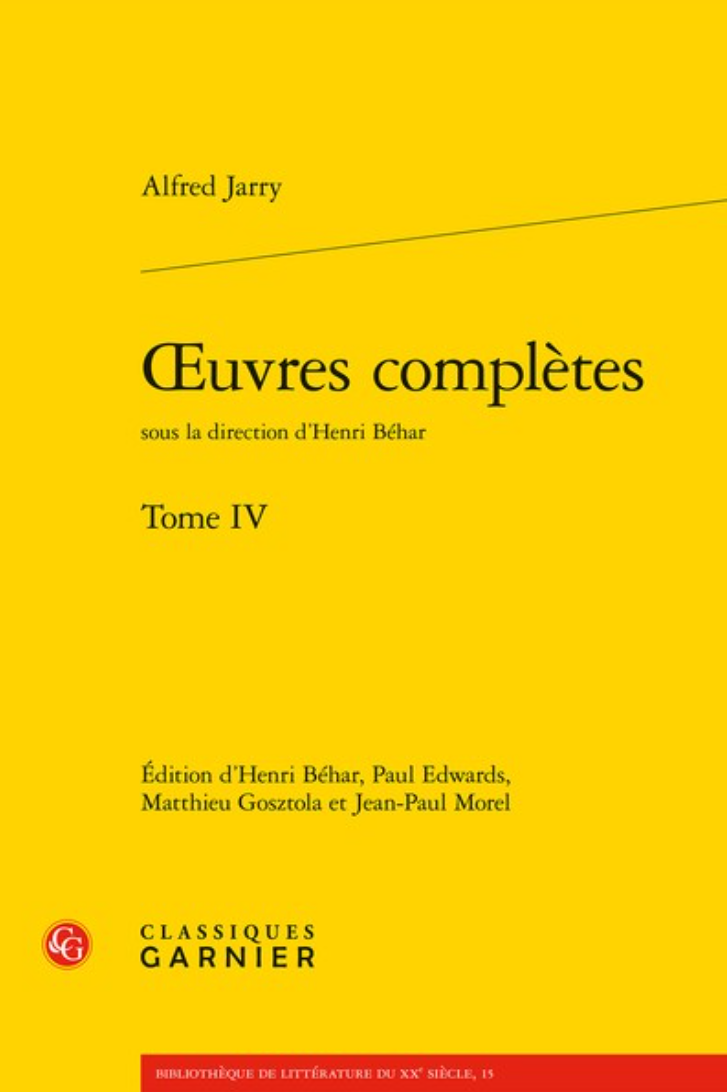
Read the text of Ubu enchaîné in our critical edition: Classiques Garnier
Ubu enchaîné, Book chapter: Alfred Jarry, Complete Works. Volume IV, pp. 19 to 71. Collection: Bibliothèque de littérature du xxe siècle, no. 15
Read the same text in digital edition Book review of this volume in Studi Francese: Ida Merello, "Alfred Jarry, Œuvres complètes t. IV", Studi Francese [Online], 182 (LXI | II) | 2017, published on August 1, 2017, consulted on July 5, 2024. I quote the passage concerning Ubu enchaîné: "the edition of Ubu enchaîné is due to Henri Béhar (pp. 11-184), who re-proposes the Natanson edition of 1899, that is, preceded by Ubu Roi. Ubu enchaîné had not made people talk about it and the Natanson brothers had preferred to associate it with the first Ubu. Béhar dispels some commonplaces: the more adult character of the text, whose origin is again placed in the high school years, the reversal of values, at the moment when Ubu passes from the delirium of royal omnipotence to the annoyance with royalty. In reality Béhar shows with finesse how Ubu enchaîné represents the double of Ubu roi, inasmuch as Ubu becomes the leader of free men, therefore always a leader, and always to satisfy his belly, simply passing from a monarchy to a dictatorship. The other characters also preserve the same role they had in Ubu roi. Béhar's observations nail the text also to its homology with contemporary dramatic structures, despite the use of youthful slang expressions or Rabelaisian lexicon. The editor recalls how the first performance was posthumous by several years: it was indeed only in 1937 that the play was staged by the Diable écarlate company of Sylvain Itkine, and used as a weapon against contemporary theater, to highlight surrealist and Trotskyist values. For a philological version one had to wait for the 1971 television staging by Jean-Christophe Averty. The text is presented with a dense apparatus of historical notes and textual philology."
Commentary on the play by Colimasson: http://colimasson.over-blog.com/article-ubu-enchaine-1899-d-alfred-jarry-121642827.html
- The numbers in parentheses refer to: Alfred Jarry, Tout Ubu, Paris, Le livre de poche, 1962.
- Starting from such an indication, one imagines the part that a Jorge Lavelli could draw from it. Unfortunately for fashionable directors, this work contains no erotic nuance, as Father Ubu takes care to specify: "By my green candle, this young person has not well understood that we were not courting her, having had the precaution, as of providing ourselves with the uncle, of hanging behind the carriage our beloved Mother Ubu." (p. 287).
- Father Ubu displaces his decor with him.
- Alfred Jarry, "Barnum", la Bévue blanche, January 1, 1902; reprinted in La Chandelle verte, Paris, Le livre de poche, 1969, p. 149-152.
- Alfred Jarry, "On the Uselessness of Theater at the Theater", Mercure de France, September 1896; reprinted in Tout Ubu, p. 143.
- The procedure will be much used, with various effects, in dada and surrealist theater. Cf. on this subject Henri Béhar, Roger Vitrac, un réprouvé du surréalisme, Paris, Nizet, 1966; see also Étude sur le théâtre dada et surréaliste, Paris, Gallimard, 1967.
- Ubu Roi, act III, scene 8.
- Cf. Charles Chasse, Sous le masque d'Alfred Jarry. Aux sources d'Ubu roi, Paris, 1921.
- Cf. on this point Michel Arrivé, "Postulates for the linguistic description of literary texts", Langue française, no. 3, September 1969, p. 9.
- Cf. on this subject Robert Garapon's thesis, la Fantaisie verbale et le comique dans le théâtre français du Moyen Age à la fin du xviie siècle, Paris, Armand Colin, 1957, 368 p.
- Let's note the substantive "menteries" (p. 303) escaped from children's language.