"FROM PLACE BLANCHE TO THE WHITE CITY" (WITH JELENA NOVAKOVIC AND BRANKO ALEKSIC), MÉLUSINE, N° XXX, P. 9-15.
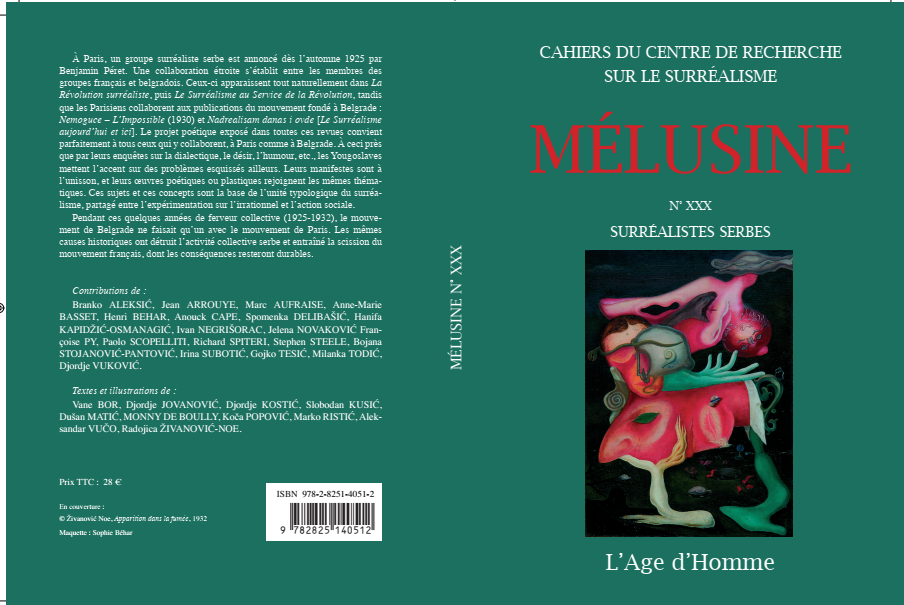
Table of contents:
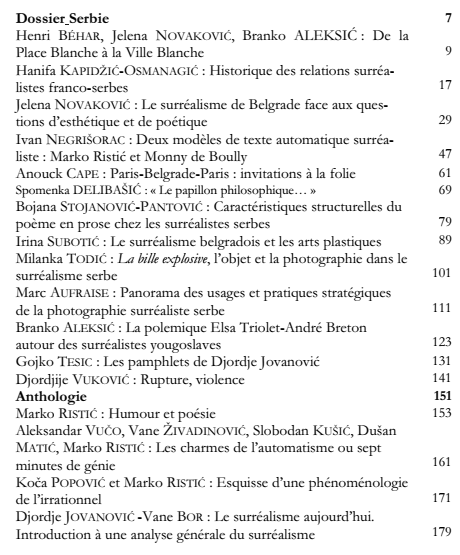
My first teaching internship took place during the summer of 1962 in Yugoslavia. This was the opportunity to frequent teachers from all the republics then composing this country, and to interest myself in their literatures. On the other hand, the publisher of the Mélusine review, whom we familiarly called Dimitri, was a Serb, which seemed to me an obvious reason to propose to him a volume devoted to the writers and artists of his country. I knew his global critique of surrealism and thought that such a work would modify his opinion. He published it without any reservation, but that didn't make him change his mind for all that!
Download the PDF presentation
Published on June 29, 2008 by Matthieu Vernet (Source: Henri Béhar)
After the publication this winter of Mélusine XXVIII, Surrealism in Heritage, The avant-gardes after 1945; volume XXIX on Surrealist architecture (to be published in February 2009) being in the process of being finalized, allow me to launch here a call for contributions for the thirtieth issue of the Mélusine review, the dossier on surrealism in Serbia to be published at the beginning of 2010, under the joint direction of Jelena Novakovic and myself.
Serbian surrealism develops at the same time as French surrealism. It is an autonomous movement and not a branch of Parisian surrealism, but its representatives (Marko Ristic, Dusan Matic, Aleksandar Vuco, Djordje Kostic, Vane Zivadinovic Bor, Milan Dedinac, Oskar Davico, Koca Popovic) maintain close relations with the surrealists of Paris (Breton, Aragon, Péret, Éluard, Crevel, Thirion) over a dozen years. It is a cooperation that takes place in both directions. They sign collective declarations, they participate together in different manifestations, they exchange letters and texts to publish them in their respective reviews. This cooperation does not rest only on personal contacts, but also on the common tendencies of the two groups, penetrated by the same spirit of insubmission and revolt, tendencies that manifest themselves by the themes they treat in their theoretical and poetic texts (position of man in the contemporary world, relationship between the imaginary and the real, rehabilitation of the irrational; apology of desire, madness, dream, automatic writing, love, death, humor, revolutionary action; relationship towards novelistic creation, the symbolism of the night, etc.) and by certain common concepts that they employ in the elaboration of their program ("surreality", "marvelous", "objective chance"). These themes and concepts are the basis of a typological unity of the two movements that evolve from experimentation with the irrational towards social action.
At once autonomous as a movement and linked to Parisian surrealism by an intense cooperation, Serbian surrealism has enriched surrealist production by a certain number of original contributions that deserve to be known in France as well. A number of the Mélusine review devoted to Serbian surrealism and organized around the following axes could account for this:
- History of Franco-Serbian surrealist relations;
- Common concepts and themes (with their specific modulations);
- Contributions of Belgrade surrealists to Parisian surrealism, and reciprocally;
- Choice of texts by Serbian surrealists (translated into French).
As usual, we wish to receive proposals (title + argument, one page maximum) by the end of this month, in order to be able to coordinate them.
The article itself not exceeding 25,000 characters, spaces and notes included (space is feminine in typography) would be expected for February 15, 2009.
Complements:
Hanifa Kapidzic-Osmanagic: Serbian surrealism and its relations with French surrealism. University Press of Dijon, 1968, 281 p.
see: Serbian surrealism, the imaginary of the night, by Raphaëlle Hérout – Mélusine
The development of surrealism in Serbia
Serbian surrealism by Serge Fauchereau.
NASA STVARNOST – Review. Serbian surrealism – Serbian surrealism.
Belgrade, 1936-39. Edited by Aleksandar Vuco. 7 volumes in 153X227mm paperback format. Nos. 3 to 13/14 and 17/18. Very rare review edited by the Serbian surrealist A. Vuco. Texts by Marko Ristic, Dusan Matic, A. Vuco, Aragon, Oscar Davico, Federico Garcia Lorca, Milan Dedinac, Paul Eluard, et al. Illustrations by Adolf Hoffmeister, Pablo Picasso, Franz Masereel, Le Corbusier, Karel Capek, et al. Good condition. See photos. (Nadrealizam, avant garde periodical, Surréalisme, Surrealismo, Surrealism).
Extensions:
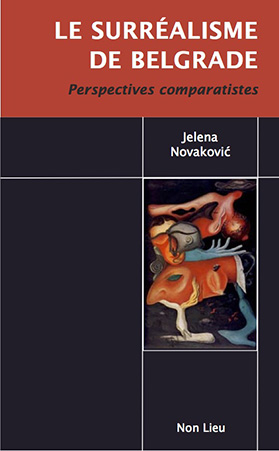
Belgrade surrealism flourished between 1922 and 1932. It developed at the same time as French surrealism, but, as an organized movement, it formed a little later than that of Paris and its duration is shorter.
The constitution of the movement is preceded by a pre-surrealist period, which begins in 1922 with the publication of the review Putevi [Paths], to which is soon added the review Svedočanstva [Testimonies], and it lasts until the publication of the bilingual almanac Nemoguće-L'impossible (1930). It should be noted that the period 1927-1930 is marked by the publication of some capital surrealist publications by Milan Dedinac, Marko Ristić, or Aleksandar Vučo.
As an organized movement, Belgrade surrealism begins in 1930, at the beginning of the absolutism period in Serbia, which will last until the Second World War (Dictatorship of January 6, 1929 and Granted Constitution of September 3, 1931) and where the surrealist spirit of opposition and revolt takes on a social and political character, in agreement with the revolutionary spirit of French surrealism.
When we speak of Belgrade surrealism, three questions arise: on what intellectual, political and literary ground did this movement graft itself in Serbia? How did it enrich surrealist production? How were its flowers occulted, to reappear, in a different way, more discreet, after the Second World War, during the 1950s.