"BEFORE THE LETTER. ARE MANUSCRIPTS LITERATURE?", IN: ALFRED JARRY, FROM MANUSCRIPT TO TYPOGRAPHY, PROCEEDINGS OF THE INTERNATIONAL COLLOQUIUM, UNIVERSITY OF REIMS, FEBRUARY 21-22, 2014. TEXTS COLLECTED AND PRESENTED BY HENRI BÉHAR AND JULIEN SCHUH, ETOILE-ABSINTHE, N° 132-133, SAAJ AND DU LÉROT ÉD., P. 13-25.
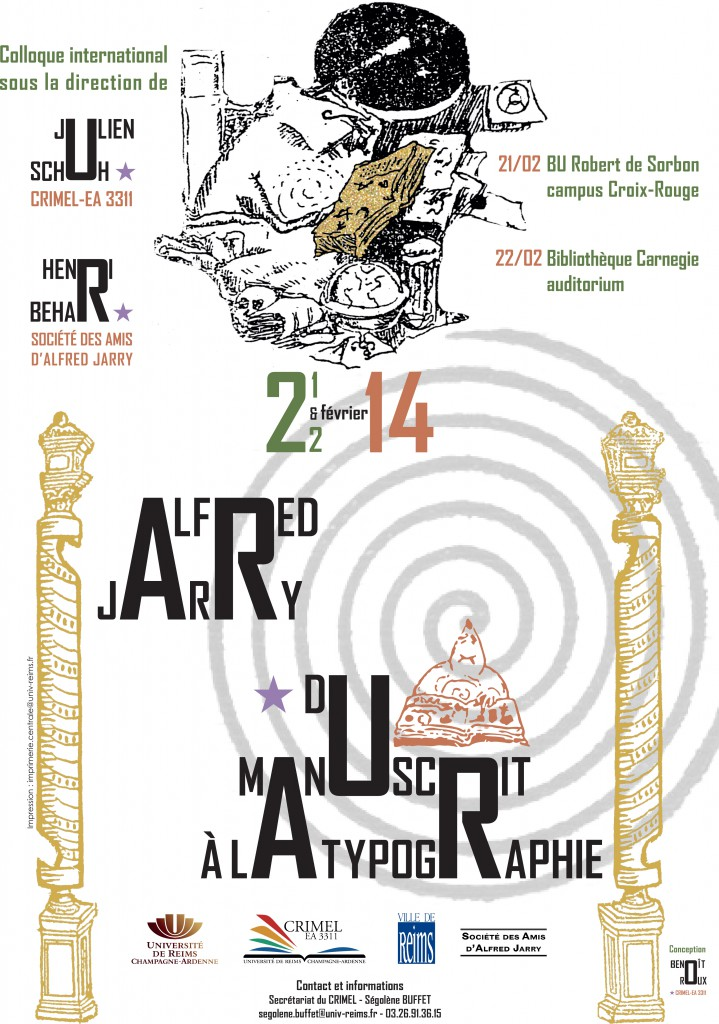
Colloquium announcement: Alfred Jarry, from manuscript to typography (fabula.org)
Exhibition: press dossier univ-reims.fr
Contents
Henri Béhar & Julien Schuh, "Presentation"… p. 7
"By virtue of writing the work": manuscripts and genetics
Henri Béhar, "Before the letter. Are manuscripts literature?"… p. 13
Yosuké Goda, "Jarry facing theatrical censorship"… p. 27
Henri Bordillon, "Marcueil in the text"… p. 49
Diana Beaume, "Thawed words. About the Pantagruel manuscript"… p. 61
Julien Schuh, "La Dragonne, a 'repertoire of the currently unrealized'"… p. 79
Paul Edwards, "Collections and crocodiles"… p. 103
Eric Walbecq, "Jarry in every letter"… p. 115
Matthieu Gosztola, "Cornering the pages, the act by which the genesis of literary criticism unfolds entirely, or The source book appropriated as manuscript"… p. 127
"Only the letter is literature": the graphic imaginary 777
Michel Arrivé, "Letter, meaning, literature"… p. 1
Marc Décimo, "Alfred Jarry facing a regent"… p. 147
Aurélie Briquet, "Silences of L'Amour absolu: blanks and punctuation"… p. 167
"Quick he prints, he prints, the printer": editing and typography
Alain Chevrier, "The typographic presentation of Jarry's poems"… p. 181
Edouard Graham, "Jarry put to the test of facsimile"… p. 199
Armelle Hérisson, "The mirlitonesque project and the Sansot opuscules"… p. 217
Clément Dessy, "Literature as craft"… p. 235
Vincent Gogibu, "Remy de Gourmont & Alfred Jarry"… p. 257
"One doesn't make great, one lets grow": posterity
Jill Fell, "A Polish trajectory"… p. 273
Anna Rykunova, "Alfred Jarry, Les Paralipomènes d'Ubu (1896)"… p. 287
Hélène Campaignolle & Sophie Lesiewicz, "Ubu LivrEsC version"… p. 299
Linda Stillman, "From presentation to exhibition: Collecting Jarry"… p. 327
Volume announcement on Fabula: H. Béhar et J. Schuh (dir.), Alfred Jarry, du manuscrit à la typographie (fabula.org)
Full text of the volume accessible on the SAAJ website
Good pages: Bonnes_pages_EA132-133.pdf (alfredjarry.fr)
Alfred Jarry, from manuscript to typography, Proceedings of the International Colloquium, University of Reims Champagne-Ardenne, February 21-22, 2014, texts collected by Henri Béhar and Julien Schuh, SAAJ & Du Lérot éditeur, Paris & Tusson, 2014, EAN13 : 9782355480935. 344 pages.
Presentation by Henri Béhar & Julien Schuh
In reaction to the book of his era, increasingly standardized, reproduced in thousands of identical copies by ever more perfected presses, but whose quality, to reduce its cost, continues to decline, Jarry seeks to conceive a form of artistic book, escaping the absolute reproducibility of the commodity. The limitation of print runs, the creation of original engravings, the use of archaizing and artisanal techniques and the development of an aesthetic of synthesis are intended to restore to these objects an aura of uniqueness and to promote other models of reception, based on suggestion, by refusing standardized reading. It is this interest in the concrete aspect of the literary experience in Jarry that served as the guiding thread for the speakers at this colloquium, organized by the Alfred Jarry Society and the Interdisciplinary Research Center on Aesthetic and Literary Models (CRIMEL-EA3311) of the University of Reims Champagne-Ardenne, directed by Jean-Louis Haquette, and supported by the City of Reims. "By virtue of writing the work": manuscripts and genetics The work on the edition of Jarry's Complete Works at Garnier Classiques has led to a return to manuscripts, some of which had not been exhumed for decades. It is known that Jarry kept all his drafts, almost maniacally, which had allowed him to constitute the collection of youthful texts Ontogénie, or authorized him to draw from his unpublished works to complete his works in progress. After a clarification by Henri Béhar, who questions the status of these manuscript objects in our editorial tradition, Yosuké Goda, Henri Bordillon, Diana Beaume and Julien Schuh Henri Béhar & Julien Schuh 8 analyze the files of certain texts by Jarry (Pantagruel, La Dragonne…) whose singularities call into question established genres and usual forms of the book. These questions also touch on his epistolary practice, analyzed by Paul Edwards, Éric Walbecq and Matthieu Gosztola, which often escapes toward literary creation or criticism. "Only the letter is literature": the graphic imaginary Jarry invites his reader to see typography rather than read the meaning of sentences, by making, for example, the grapheme X a central element of the collection, a lineament symbolizing at once the hourglass, the infinity sign (∞), the cross of Christ or tombs or even the form of a barn owl. Like the old engravings of L'Ymagier, like his own synthetic drawings that stand out against a dark background, Jarry's texts are meant to be read as emblems whose simplified lines are susceptible to several interpretations. The games between letter and meaning are the subject of interventions by Michel Arrivé, who compares the theories of Jarry and Saussure, and Marc Décimo, who presents the biography of one of these renovators of spelling who delighted Jarry the chronicler, Jean-Marie Chappaz; Aurélie Briquet, for her part, explores more broadly the relationships of a text like L'Amour absolu to its layout. "Unfolding and explaining, debrainer, / Quick he prints, he prints, the printer": editing and typography Jarry's interest in typography is revealed very early. In June 1894, he sends a letter to Alfred Vallette, the director of the Mercure de France, about the layout of "Haldernablou," the first work of fiction accepted in the columns of the journal: "Regarding the proofs, I compared with terror the length of the verses of the Choirs with the format of the Mercure. I think it will take seven roman, and moreover I prefer to leave you carte blanche for the characters, I recognize that I am still quite inexperienced in typography." Remy de Gourmont, who introduces him to the Mercure and serves as his mentor, is himself an adept of typographic experiments. Together, they publish from 1894 the journal L'Ymagier, which often reproduces facsimiles of pages of old books for the beauty of their characters. Jarry draws inspiration from Gourmont's books in the composition of the title pages of Minutes de sable mémorial and César-Antechrist. The two writers fall out in 1895; Jarry creates in January 1896 a competing print journal to L'Ymagier, Perhinderion, for which he has specially cast a typeface inspired by those of the Renaissance: "The punches of the beautiful characters of the fifteenth century have been found for us, with the abbreviated letters, of which we give only an imperfect example with our two chapters of Sébastien Munster, but which will be cast with the greatest care and will serve specially for our texts from fascicle II" ("Premier son de la messe", Perhinderion, n° 1, March 1896, n. p.). Jarry ordered these Mazarin printing characters from Renaudie, the printer of the Mercure de France, in March 1896. He could afford this kind of expense, having just received his paternal inheritance; this font will only be used for the printing of the second and last issue of Perhinderion, and for Ubu roi, whose printer's note of June 11, 1896 specifies that it was composed "with the characters of Perhinderion". In debt, Jarry sold these characters to Renaudie shortly after; they are found in certain publications of the time. Paul Fort's pamphlet, Louis XI, curieux homme, published the same year, also uses these characters; the third page of the work specifies: "Printed with the characters of Perhinderion". Ferdinand Herold's Pastoral Interlude (Paris, Le Centaure, 1896) also uses Jarry's Mazarin. The title characters of Ubu roi, reused in 1897 on the cover of Gourmont's Vieux Roi, are not those of Perhinderion, as is sometimes written; they are already found, in different sizes, in Le Livre d'Art, from the first issue of March 1896. This attention to typography guides Alain Chevrier's investigations into how Jarry's poems have been reformatted since their first edition; Édouard Graham's, who places the autographic edition of L'Amour absolu in the context of the era; and Armelle Hérisson's, who analyzes the files of the mirlitonesque collection pamphlets at Sansot that Jarry did not finalize. Clément Dessy and Vincent Gogibu explore on their side Jarry's relationships with two other lovers of the flesh of books: Max Elskamp and Remy de Gourmont. "One doesn't make great, one lets grow": posterity Jarry's typographic experiments inspire writers and book artisans throughout the century following his death ("One doesn't make great, one lets grow," he declares in Le Surmâle). His deliberately synthetic drawings and engravings are the subject of reappropriation by artists like Miró or Picasso; Ubu's attributes are reimagined by his illustrators, and typographers translate their interpretations of his aesthetic into the very form of books. Jill Fell describes the tragic history of the Polish passeurs of Ubu roi. It is a much more recent experience of illustration and artist's book, that of Serge Chamchinov, that Anna Rykunova analyzes. From book to digital library, Hélène Campaignolle and Sophie Lesiewicz present Jarry's place in the LivrEsC database, devoted to the book as a space of creation. Finally, Linda Stillman delivers the point of view of a collector passionate about Jarry in the story of the constitution of her collection of manuscripts and original editions placed under the sign of the gidouille.
Download Henri Béhar's article PDF
Below, the article in full text:
Before the Letter
Are Manuscripts Literature? Henri Béhar
The expression "before the letter" is generally used to designate a lithograph printed without its legend. Having the formidable charge of speaking first, before all the specialists of the manuscript, of the letter, of the printed thing, I will therefore position myself a little ahead, asking the question of the innocent who doesn't understand why amateurs engage in pitiless auctions, aiming to acquire who an autograph manuscript page, who a princeps edition, who an illustrated book with original engravings.
By dint of scrutinizing the drafts and slightest notes of writers, I come to wonder what necrophilia pushes us to exhume what, as a general rule and for any other craft, one sweeps away with a negligent broom toward the wastepaper basket.
On several occasions publishers have asked me to designate the most beautiful French manuscript of the twentieth century. I have never hesitated since I saw it in its author's workshop and in the hands of its recipient: it was, for me, the manuscript of Arcane 17, carefully ordered by André Breton and since then preserved by Elisa. It was indeed the first draft manuscript, as they say, and not a more or less reworked copy for the printer. I made sure to find a publisher as crazy as me to share my opinion and deliver to the public a complete facsimile of the work, accompanied by its no less complete transcription. And then, faced with the difficulty I had in deciphering crossed-out and overlaid words that, inevitably, brought me back to the initial writing, in other words for an intellectually almost nil gain, I swore they wouldn't catch me again. For me, the most beautiful manuscript of the twentieth century would be the last one I will have published.
In preparing the new edition of Alfred Jarry's Complete Works for Garnier Classiques, my collaborators and I had set ourselves the ambition of providing the equivalent of Corneille by Marty-Lavaux, Racine by Paul Mesnard, or even Mme de Staël by the Countess Jean de Pange, in the collection Les Grands Écrivains de la France, which I noticed, in passing, was currently available in digital form. And here the ordeal was beginning again, in a different form certainly, but with the same intention, as if there were a mystery to discover under the words of autograph manuscripts! As if the editorial chain were organized so as to lose what made all the value of a manuscript and as if we, poor literary laborers, had nothing better to do than gather the dust of a buried treasure!
I therefore thought it worthwhile to mark a pause and question a practice more than a century old, in order to examine its current relevance.
Reminder: objective of the colloquium
Contrary to the law of generalized entropy, which also affects autograph writing, the more time passes, the more Alfred Jarry's manuscripts resurface. The new edition of Alfred Jarry's Complete Works, to which I refer, has led us to systematically resort to them for the establishment of the text and variants. It is appropriate to go further, and to show Alfred Jarry at work, before the blank page, and then facing the proofs (I speak here of the printed text as it comes out of composition), finally in his typographic choices.
The return to original editions, which are often works of art, whose paper, illustrations and typographic layout, chosen with care, are not maintained in later editions, also requires reflection, even the establishment of a strategy and even a collective charter. In this regard, the Municipal Library of Laval has played a central role through a constant policy of acquiring manuscripts and original editions, and systematic digitization of its purchases:
http://alfredjarry.fr/oeuvresnumerisees/index.php
Added to this is the catalog of the Departmental Archives: Alfred Jarry, Around a Testament. Archive catalog by Joël Surcouf, Laval, Departmental Archives of Mayenne, 2007; as well as the volume of the previous colloquium of our Society, Jarry and the Arts available online:
http://alfredjarry.fr/amisjarry/fichiers_ea/etoile_absinthe_115_116reduit.pdf
and more broadly the collection of the journal l'Etoile-Absinthe, source of numerous documents: http://alfredjarry.fr/amisjarry/saaj/etoileabsinthe.htm
The editing protocol
The collaborators approached by Garnier Classiques editions received a protocol setting out the principles that should guide their work.
Without divulging industrial secrets here, I believe I can reveal the rules perpetuated by a multi-century publishing house.
Scientific editions that make their mark
The publisher intends to publish only works of scholarship of the highest scientific standard. This character is justified both by the establishment of the text and by the annotation.
These two traits belong to a tradition called philological, which goes back, we will see, to the perspectives traced by the New Sorbonne, at the beginning of the 1900s.
Text choice
By definition, the publisher only publishes "classic" works, those that will be taught, at whatever level of the educational system. This is indeed the case for Jarry's work which, whatever one may say, does appear in the program of the Collège de 'Pataphysique and, since 1985 in the Petits Classiques Larousse, not to mention the Livre de Poche and the Bibliothèque de la Pléiade.
It must be a text approved and revised by the author before his death.
Usage wants that one choose as a starting point the last version approved by the author. However, this is only a usage, and it is quite possible to start from another version, provided that the choice is justified.
As far as our author is concerned, the problem hardly arises, since he left few unfinished and unpublished manuscripts, with the exception of La Dragonne, one chapter of which appeared in a journal during his lifetime. However, choices must be explained in the case of posthumous works: Jarry planned a regrouping of articles already published in journals (La Chandelle verte).
Text establishment
Resolutely modern in its respect for tradition, our publisher advocates two simultaneous editions for the same work. One virtual, the other on paper.
- For the electronic version: the establishment will be rigorously diplomatic, the only means of subsequently studying workshop practices, orthographic evolutions, etc.
Let us recall that "diplomatic" is the most faithful possible reproduction of a text. And what is more faithful than the snapshot of each page (we speak today of scan) accompanied by a typographic transcription?
In this case we will correct printer's errors, indicating this in the notes.
- For the printed edition, the publisher distinguishes works prior to the seventeenth century from subsequent ones. The first have their canonical model: the rules applied by Paul Laumonier (1867-1949) in his edition of Ronsard's Complete Works, which explicitly refers us to Lanson and his school.
From the seventeenth century onwards, he suggests adopting modern spelling, particularly for accentuation and punctuation, while respecting ancient usage for capitals as well as original spelling at the rhyme, in case modernization would produce a false rhyme.
Systematic or punctual changes will obviously be indicated in a note.
Particular attention is paid to variants, numbered alphabetically for each page, but placed at the end of the text itself. This typographic arrangement is undoubtedly the most debatable, insofar as it obliges the reader to a small manual and intellectual gymnastics. But it will be compensated by the image, in the digital edition.
This is, however, what seems to confer on the edition its absolutely scientific character, since all classic publications, including pocket format, are now abundantly annotated.
The instructions concerning annotation are very precise. Paraphrase, or what resembles it, is strictly prohibited. On the other hand, space is not measured for notes of historical, linguistic and referential type.
From experience, I would say that one must not crush Jarry's text under erudition, nor alienate the reader with long allogeneic quotations. Only practical considerations should guide us, for example when the text to which we refer is no longer accessible.
Finally, to finish with these instructions, it is recommended to offer the reader a glossary and an index of proper names, even topographical, if applicable. Useless in the digital edition, since the machine searches for any word at the speed of light, the index obviously imposes itself for the paper version. On the other hand, the establishment of a Jarryesque glossary did not seem indispensable to us, at the stage where we are, since the singular words are explained and commented on in the notes, with cross-references from one occurrence to another.
In several cases, particularly for the articles of La Chandelle verte, the question of annexes and appendices arose. Here again, these documents deserve to be reproduced if they are no longer accessible, insofar as they are necessary for understanding the environment or sources of the work.
What justification?
An observer from elsewhere, foreign to our work, would be entitled to say that, with the exception of a few mentions of the digital, such a protocol differs in nothing from what could command the scholarly editions of the nineteenth century.
However, there are many who, like us, have subscribed to such a protocol in the concern to produce scientific editions of modern and contemporary authors. Does this mean that nothing would have changed since the foundation of our science of literature?
We will see that, without renouncing the past, it is here a question of surpassing traditional methods with the double aim of serving authors and the public of today.
Manuscripts as documents
For the founding fathers of this type of edition, it was appropriate to distinguish the "mass of documents – manuscripts or printed – which are only documents" from the literary works themselves1.[1 Gustave Lanson, Essays on method of criticism and literary history collected and presented by Henri Peyre, Hachette, 1965. The article to which I refer, "The method of literary history," appeared in the Revue du mois on 10-10-1910.]
These are defined according to the public on the one hand; according to their intrinsic character on the other. In other words, what makes literature for Lanson is literariness. And if, in one leap, I move to reading Roman Jakobson, I fall back on the same aporia.
So let's see what these documents that are only documents are. How do they articulate with literature? Would they only be the object of literary science?
To know a text, Gustave Lanson enumerates nine questions to which the professional must be able to answer. It would be tedious to quote them all at length. Let us retain that they concern the authenticity of the text, its purity and integrity, its dating, its transformations since the original edition, its elaboration, its literal meaning, then literary, the modalities of its elaboration, its fortune (today transformed into critical reception), to finish.
Such is the work assigned to the scientific editor, who must also be able to answer a tenth objective: to establish the relationships of literature to life, to society.
The task is arduous. It does not concern only the professionals of literature since these work for the public, for the nation even, I would say, taking up Lanson's terms.
To illustrate this aspect of critical editing work that no one contests until now, I will take the canonical example of the two manuscripts of Gestes et opinions du Dr Faustroll. Far from belonging to erudition alone, the recording of variants and their comparison allows us to measure the variations of the Doctor's taste (and consequently of the author) for such and such a book pair and, in each book, for heterogeneous images, now constitutive of his mental universe. The same goes for changes in dedications or dedicatees, thermometers of his affections. No need to say more: on the level of the fabrication of the text, the reader will find complete satisfaction in the various editions of this "neo-scientific novel," in pocket format or in 8°, of which the latest recapitulates all previous acquisitions, adding new perspectives, as it should.
Our documents
The mythical manuscript of Ubu roi, which Paul Fort claimed to have saved from the fire, has still not appeared2. [2. Paul Fort, My memoirs, Flammarion, 1944, p. 52. He suggests that Jarry, hostile to the edition of Ubu, was going to burn the manuscript that his friends had put in order, and had it snatched from him after a violent fight.]
However, our editorial team was able to consult, for the greatest benefit of readers, a beautiful harvest of Alfred Jarry's first-draft manuscripts, which had not been shown at the Expojarrysition of the Collège de 'Pataphysique, in 1953. Little concerned with establishing a ranking, I will content myself, here, with evoking the places where the most interesting autograph documents are found.
To every lord, every honor. I will first cite the Jarryesque treasures preserved by the Municipal Library of Laval, which is undoubtedly not the first nor the richest in this field, but which has the will to capitalize, within the limits of its means, all the first-hand documentation relating to its illustrious fellow citizen, as proved, for example, the colloquium gathered in this same place for the centenary of his death. In addition, it has adopted an international opening policy by digitizing everything it holds, which is therefore accessible via the network.
This library has therefore acquired the following manuscripts, which can be consulted on the network in PDF format:
Albert Samain, 1905. La Dragonne, 1906. Spéculations, Ms before 1907.
Ubu sur la butte, Ms written on a printed copy of Ubu-Roi, 1901. Ubu Roi, addition to the final scene arranged for Guignol, Ms, 1901. L'Objet aimé, Théâtre mirlitonesque, 1903.
Messaline – Novel of ancient Rome. Ms before 1901. Le Surmâle, Ms before 1902.
This is to say that the reader wishing to identify Jarry's handwriting, or to see what a page of Spéculations looked like, the rewriting of a text, the occupation of the page, the dynamics of writing, in short, can satisfy his curiosity.
However, our work cannot stop there, and our team has had to and been able to consult the manuscripts found in the other public libraries of France.
In total, it is about a hundred autograph documents by Jarry or relating to his work. They are found in the Departmental Archives of Quimper; at the Municipal Library of Reims, and especially at the BLJD with the Faustroll having belonged to Tristan Tzara, the Conférence sur les Pantins, the Projet de réunion des 3 Ubus, not to mention the correspondence with Rachilde, Vallette and all the companions of the Mercure de France; the precious "Inscription placed on the great history of the old lady", "La bataille de Morsang" intended for La Dragonne, the first part of La Papesse Jeanne, a fragment of Léda, and the unexpected notes taken during Bergson by Jarry himself.
Beside these riches, the rare autograph manuscript documents preserved at the BnF make a pale figure. Besides the correspondence, they relate to L'Amour absolu and Les Jours et les Nuits.
Finally, the Picasso Museum holds a letter from Jarry to the young Master.
The trade in manuscript documents and, more precisely, the absence of a national policy in this area, has meant that a good number of pages written by Jarry are now found in the USA.
The exhaustive catalog will be found in appendix. So as not to tire the audience, let us cite the most beautiful pieces: Ontogénie, Léda, La Dragonne, acquired by Carlton Lake, accessible at the Harry Ransom Center of the University of Austin, Texas.
Yale University, for its part, distinguished itself by purchasing the library of F.T. Marinetti and his relations. This is how, besides letters from Jarry to the director of Poesia, we find there proofs of the mirlitonesque theater and pages now collected in La Chandelle verte.
For reasons I cannot explain, a certain number of collectors, in France or elsewhere, insist on maintaining anonymity. Thus it is only possible to consult in photocopy the manuscripts of Faustroll, Ubu cocu, Les Jours et les Nuits… Their variations have nevertheless been exploited.
How and why do autograph manuscripts reach us?
The truism has been noted many times: any work of establishing texts from manuscripts can only be carried out insofar as someone (the author in particular, but not only him) has taken care to preserve different states of the manuscript, ranging from the draft, the first idea thrown on paper, all that following Jean Bellemin-Noël we call "avant-texte" on the one hand, to the definitive manuscript, then to the corrected proofs, finally to the "text" properly speaking, guaranteed authentic by the author's BAT (Bon à tirer), not to mention the copies subsequent to printing made by the author himself for various purposes, and, of course, the multiple re-editions.
In the Gutenberg era, the idea of preserving a manuscript prior to the original edition could only have an aesthetic, sentimental or symbolic value.
With age, memory only retains bad memories, and I remember very exactly the platitudes that an illustrious Sorbonicole served me when, in presenting a literary study of La Fontaine's poem Adonis for the agrégation, I observed that the author had had it calligraphed by… Nicolas Jarry to offer to Fouquet in 1658.
Certainly, the calligraphed manuscript is not the autograph, and it belongs to a certain aesthetic tradition. However, it no less testifies to the symbolic value that its sponsor, who happens to be the author himself, accords to the copy of his own manuscript, as well as to the binding that will serve as protection and setting for future centuries.
Despite this slight displacement, let us retain this date, in the middle of the seventeenth century: it marks, globally, the moment when the manuscript takes on an autonomous value and will be the object of various appreciations, opening the way to a specific function of the book trade. Still the poet, by modesty it seems to me, considered that his own writing did not deserve to pass to posterity.
The commercial value of the manuscript, which has only grown with time, will be the subject of several communications, which are not without relation, obviously, to the quality attributed to the work itself.
Although they could not escape it for their own work, this museal and commercial aspect of the literary thing did not come to the mind of the virtuous founding fathers of the Third Republic of Letters. For them, the avant-texte was first and foremost the mark of a work that, like all manual work, deserved respect, even a certain sacralization: mechanical reproduction could multiply errors infinitely, only the manuscript, issued from the controlled will of the author, made faith. Apart from the legal aspect of the approach (what is called attribution criticism, which can be exercised in the case of Jarry's Théâtre mirlitonesque, for example), we see the predominant idea that makes the author the supreme authority (thereby making him solely responsible before the law) and which, above all, seeks to retrace the approach by which one attains the masterpiece. To the manuscript as art object, collector's piece, succeeds the manuscript as witness of artistic progress. In 1923, Gustave Rudler thus summarized the principles of critical editing: "to illuminate the procedures of invention, the march of thought, the movement of style, in a word the genesis of the work." (Techniques, p. 81) He speaks well of genesis, opening the way to a whole section of current criticism, genetics, to say everything. In truth, a student of Lanson, he will stick to the rules of text establishment as I recalled them previously, consigned in the evoked contract, of which one can say, without shocking anyone, that they belong to a positivist ideology. If it is necessary to accompany the scientific edition of a text with notes of an encyclopedic character on the one hand (called by a number) and a recording of variants (called by a letter in superscript) on the other hand, it is to help understand the work, of course, but also aesthetic appreciation. The work of the text can only aim at perfection by taking into account established rules (agreement of tenses, genders, numbers) or implicit ones, particularly with regard to euphony, rhythm. In short, by bringing to light the initial version of a sentence, a segment, the critic acts as an admirer of fine work. We have even seen, belonging to the same Lansonian school, draw from these recordings of variants recommendations in matters of beautiful language (see Albalat).
This time is over. Similarly, scholarly criticism, nowadays, no longer accords supreme value to the last text published or revised by the author during his lifetime, insofar as only the brain death of the individual attests to the end of retouches. Some scientific editors sometimes come to invert the rule by publishing in extenso a primitive state of the work, as happened to us with Ubu cocu. Not that this state was better than others, but because it testified more precisely to juvenile writing, and because we avoided the reader advancing while constantly looking in the rearview mirror or, more precisely, by referring to the final pages where the variants are unfortunately placed.
In any case, the material provided in these variants is useful to the geneticist, like a DNA fragment to the biologist. But it is in no way the complete DNA that genetic studies require.
Genetic perspectives
According to the current state of literary research in France, it would seem that, of all the methodologies practiced formerly, only literary sociology and genetic criticism remain, the latter very much alive, with its journals, collections, institutes. Unlike traditional textual criticism – to which it refers when needed –, this presents itself as a dynamic, consequently in relation to previous static approaches.
With the exception of a few punctual articles, noted in the preparatory bibliography of this colloquium, this is not however the case for what concerns Jarry's work, taken as a whole or even as a unit. All the more reason to provoke it, despite the difficulties encountered. And I will not hide my satisfaction at having seen appear the intervention proposals that constitute, without going further, the present morning.
Diana Beaume will treat an unfinished, infinite text; Yosuké Goda will offer us a genetic rereading of Ubu sur la butte, and Julien Schuh will seek to get out on top of his reading of the La Dragonne manuscript.
Manuscripts as literature
However his manuscripts have reached us, it is clear that Jarry held them as objects or, better, literary facts.
On the one hand, his work belongs to what geneticists call "writing with redactional triggering," without preconceived plan, without drafts, almost without retouches. Everyone here knows by heart the way of doing attributed to a character in Les Jours et les Nuits whose traits refer to the author himself: "Sengle constructed his literatures, curiously and precisely balanced, by sleeps of a good fifteen hours, after eating and drinking; and ejaculated in some wretched half-hour writing the result." Paradoxically, but this cannot surprise readers of Faustroll, we find there the principles of programmatic writing, which, by principle would refuse any program other than a stable and symmetrical construction.
On the other hand, and this is a simple observation on my part, we have been able to draw up the list of a thousand pages of text states prior to printing, ranging from the true draft to the autograph manuscript provided to the printer. And this in all the genres practiced by Jarry: theater, novel or narrative, reviews and speculative articles. Certain complete texts (Les Jours et les Nuits, Gestes et opinions du Docteur Faustroll), found with collectors, could be the subject of a financial transaction. Others remained in the hands of a friend, a publisher, or simply abandoned in the offices of the journal that had published them.