André Breton, digital chronology
1915 – 1918 AB mobilized
February 19, 1896
Birth of André Breton in Tinchebray (Orne) on February 19 at 10 PM (not yet 10:30 PM as AB writes on a postcard addressed to Paul Eluard from Tinchebray, August 5, 1931 (AB-Eluard Correspondence, Gallimard, 2019, p. 231)).
For sentimental and personal reasons as well as astrological ones (cf. Daily Magic, III, 930), AB will date his birth to February 18.
I say February 19, 1896: the civil status record is absolutely clear and incontestable, confirmed by baptism certificate, military record book, university registration in Nantes and the poem Age (I, 8). The subject himself chose to say he was born on February 18, Mardi Gras, for a sentimental reason that will be seen later, and immaterial astrological reasons (cf. Daily Magic, III, 930).
February 29, 1896
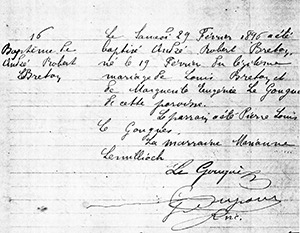
He is baptized 10 days later at the parish church. His maternal grandparents are the godfather and godmother. baptism certificate photocopy.
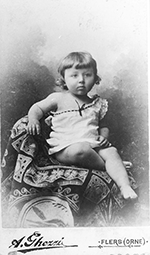
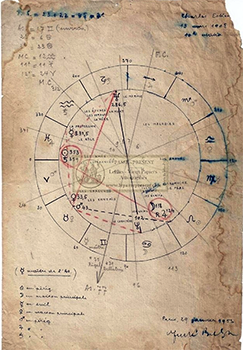
AB will initiate himself to astrology and show himself very active in this field. Below is his astral chart with his autograph signature.
Parents
Father
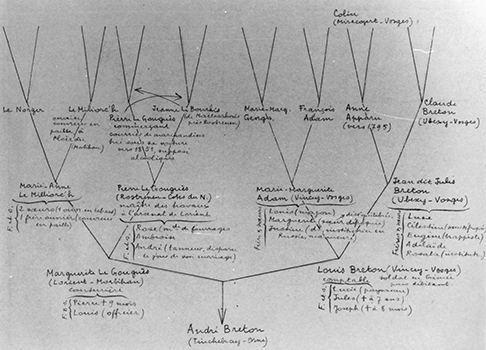
On the paternal side, AB has Lorraine origins, contrary to what his surname might suggest. Concerned about his origins, AB himself drew up, in the thirties, his genealogical tree going back to his great-grandparents {another state is preserved at the BLJD}
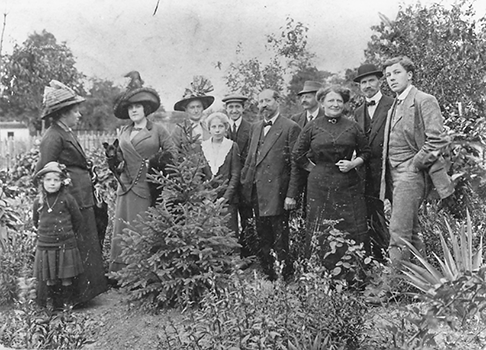
The father, Louis-Justin Breton (In the Garden of Gagny in September 1912, To the right of André his father and mother), born March 26, 1867 in Vincey (Vosges), died November 10, 1955 in Lorient, from a winegrower father in Ubexy (Vosges), canton of Charmes, birthplace of Maurice Barrès, whom AB will quote with deference: "I am not far from thinking, with Barrès, that 'the great affair, for the preceding generations, was the passage from the absolute to the relative' and that 'it is a question today of passing from doubt to negation without losing all moral value' (The Lost Steps, I, 194) before bringing him to trial in 1920 {see below}. AB's paternal grandmother, née Marie-Marguerite Adam, was an embroiderer. Two of her children having died in infancy, remained a daughter, Lucie, living in Ubexy, with whom André will spend vacations until the beginning of the 1914 war.
Louis Breton provides a fine example of social advancement under the Third Republic. At the end of school, with his primary school certificate, orphaned by his father for a year, he works in the small businesses of Ubexy. Family support, he is exempted from military service. He nevertheless signs a voluntary 5-year engagement in the army. Incorporated March 15, 1888, in the 62nd infantry regiment, in Épinal. Six months later he is corporal-quartermaster, sergeant then sergeant-major, in charge of a company's supplies. At the end of his contract, he is transferred to the reserve. He then enters the gendarmerie. One of his superiors (who will have a fine career and end up as head of health services of the Nantes military region) introduces him to his sister, Marguerite Le Gouguès, whom he marries in Lorient, September 2, 1893.
Tinchebray (Orne)
Assigned to the Orne gendarmerie company on February 17, 1894, Jules Breton handles administration in Tinchebray, where, 2 years later, his only son, André Robert Breton, will be born. The municipality will be grateful to him since it baptizes the primary school and a street with his name.
AB will recall certain images of his early childhood in Tinchebray: "I am beginning to believe in bluer dresses before the bed above lace, my mother's work." (OC I, 60)
Maternal side: Brittany
Besides a bedspread by Mme Breton awaiting her child which he kept until 1965, he evokes in counterpoint an engraving presenting the death of Marceau, which terrified him.
Marguerite Le Gouguès was born July 1, 1871 in Lorient, where her father is a carpenter at the Arsenal, and her mother, née Le Miloch, is a home embroiderer. She is from a Morbihan family, from Rostrenen and Plœrdut, in the countryside. Her parents' brothers and sisters practiced the professions of: fodder merchant, carter, tanner (mysteriously disappeared on his wedding day, his first name André, will be given to the poet, as if to transmit his freedom to him); the maritime registrant will die in Saigon, while the youngest will deliver agricultural products. AB wanted to verify his origins himself by going to consult his ancestors' registers in the different town halls, led by Valentine Hugo, in her car, accompanied by Georges Sadoul, in July 1931.
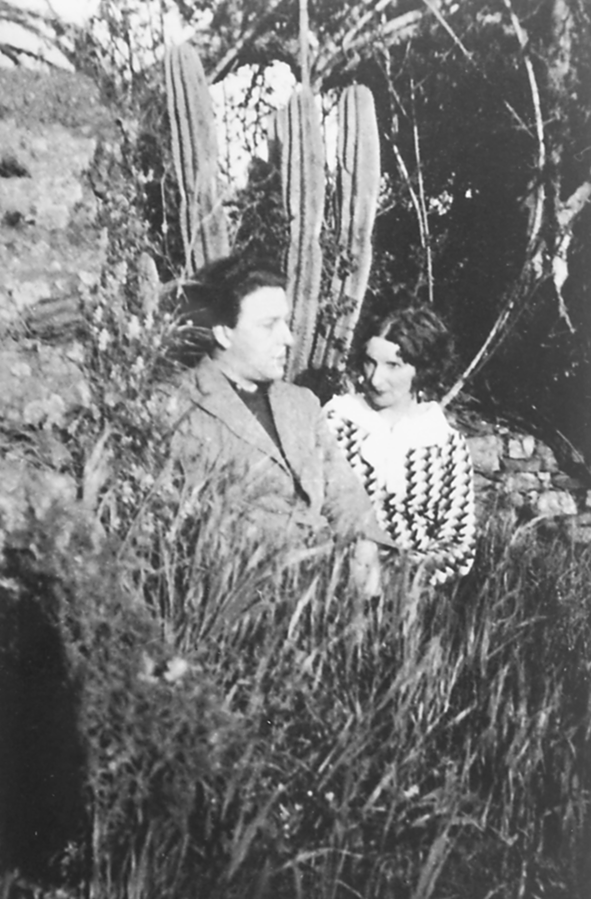
AB hardly expressed himself about his mother, whom he judged excessively devout, imbued with bourgeois propriety. This is all the more understandable when one knows her modest origins, her limited education, and her need for social integration. Thus, she was never heard to express herself in Breton, while the inhabitants of the village from which her family comes insist, today, on speaking this language. "I only speak at table after my mother (to say the exact opposite)." (Letters to Simone, 08/30/20) It is as much to this unloving and unloved mother, as to his father that AB owes being a man of the earth, as the painter André Derain will tell him (OC I, 11; I 247).
The fact that his parents chose to spend their retirement in Lorient explains that AB frequently spent his vacations by the sea or on islands.
1898
Louis Breton resigns from the gendarmerie after 4 years of active service to go to Paris, 168, boulevard Montparnasse. He works in a bookstore.
AB will have spent only his first 2 years in Tinchebray, which will not have left him many memories: the bedspread made by his mother (see above), a chromo hanging on the wall, "The Ages of Man (this chromo still exists)" he writes in the margin of the manuscript of The Magnetic Fields (Change, The group, the rupture, p. 13).
Then, raised in Lorient by his Breton grandparents, notably by his maternal grandfather, retired from the Lorient arsenal. The latter also takes him to Saint-Brieuc, which he evokes in the same text: "I leave the Dolo halls early in the morning with grandfather. The little one wants a surprise. These penny cones have not been without great influence on my life." (The Magnetic Fields, I, 58). The ancestor spent some time with him near the fountain and washhouse, in Dolo (22270) or even in Ploufragan (22240), near Saint-Brieuc, house which he saw again, unchanged, in 1953, and in front of which he has himself photographed (The Magnetic Fields (André Breton) (andrebreton.fr).
This ancestor concretely initiated him to Breton popular culture, explained to him the use of plants, rue for treating foot corns, the fleur-de-lis preserved in alcohol for cuts, who made him listen to the washerwomen's song and told him the frightening stories of korrigans, and even the ankou, whose rusty cart announces the deaths of the year. This grandfather died at 80 in Lorient in December 1917, his wife surviving him until 1922 (she died at 83).
1900
Louis Breton settles in Pantin (Town Hall) with his family. He is then an accountant at the Pantin Crystal Works, rue de Paris (current avenue Jean-Lolive), then at that of the Quatre-Chemins, the Legras factory, of which he will become the deputy director. (see Poetic investigation on André Breton's footsteps in Pantin by Julien Barret). They then live near the match factory. Paul Valéry will thus envy the young Breton for evolving "among the petticoats of the cocottes," (Interviews, OC III, 434).
At the end of the First World War, Louis retires to Lorient, at less than fifty, making fruitful the shares and bonds acquired by family father investments. He has two rental buildings built there. In 1935, he acquires by auction a city plot, rue Léo Le Bourgo, on which he builds a solid two-story dwelling with two garages (it will resist the Allied bombings of 1943-1944). By deliberation dated 04/10/1987, the municipal council created rue André Breton in the city center.
When his son decides to abandon his medical studies, he intervenes with Paul Valéry (see Louis Breton to Paul Valéry, Lorient, March 22, 1920) to try to bring him back to reason, and thank him for his intervention with potential employers (his letters, preserved at the BnF, are of beautiful stylistic elegance). While his wife refuses to attend André's strictly civil marriage with Simone Kahn, he makes a good showing.
October 1900 in Pantin, AB attends the Sainte-Élisabeth Kindergarten 5 rue Thiers (became rue Condorcet).
1901
October 2, 1901 Enters the Sadi Carnot communal primary school. He will relate certain class memories: "They also reminded me of my distant childhood, the time when, at the end of classes, much more terrifying stories, which I never could know where he got them from, were told to me and my little six-year-old classmates by a singular Auvergne schoolmaster named Tourtoulou." (AB, The Communicating Vessels, II, 174)
Teacher: M. Tourtoulou. Born in 1861, entered primary education in October 1880, transferred to the Paris city staff in 1905. He then lived rue Pelleport, in the 20th arrondissement (cf. Directory of Education, 1906). see André Breton Dictionary, art. Castle and art. Education, see the Maitron Tourtoulou.
Pantin's homage to Breton, room in his name 25 rue du Pré Saint Gervais, 93500 Pantin. As well as a media library at the 4 chemins, Aubervilliers: https://www.tourisme93.com/mediatheque-andre-breton-aubervilliers.html
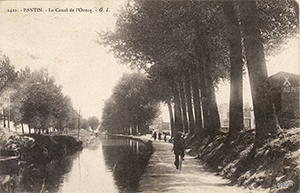
For what concerns the atmosphere of Pantin which inspired the future author of Mad Love, see a set of old postcards.
August 6, 1905
Obtains the honor prize, and the first prize in reading, history, sciences, geography and civic instruction, the second prize in calculation and manual work, the third in drawing. "I go down a monumental staircase with prize books. I only see certain collections of notebooks from school. The Picturesque Scenes with that rare ragpicker, the great cities of the World (I loved Paris)" (Seasons, I, 59). He receives several prize books, including Costal the Indian by Gabriel Ferry: "The splendid illustration of popular works and children's books, Rocambole or Costal the Indian, dedicated to those who can barely read, would be one of the only things capable of moving to tears those who can say they have read everything." (I, 239)
"I do what I can so that my parents have company in the evening." (OC I, 59)
1906
In "première supérieure" at the communal school, he prepares the entrance exam for the Collège Chaptal, and initiates himself to German, he acquires the subjects of the 6th grade class under the direction of a single master, M. Simonnot.
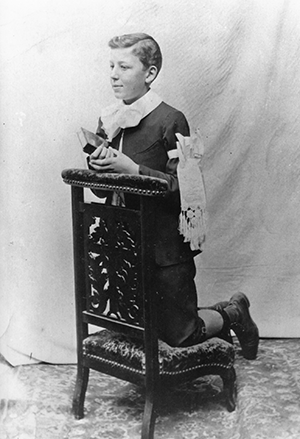
The child "Draws inspiration from the boxes he received for his communion" (I, 96) Similarly, "I do what I can so that my parents have company in the evening." (I, 58): He appreciates the days spent in the commune's workers' gardens. More generally, he will keep an emotional memory of the Ourcq canal, of the atmosphere of the Quatre Chemins, which will return regarding Jacques Vaché, Dada visit projects and especially Suzanne Muzard, the heroine of Mad Love, herself born in the neighboring commune of Aubervilliers.
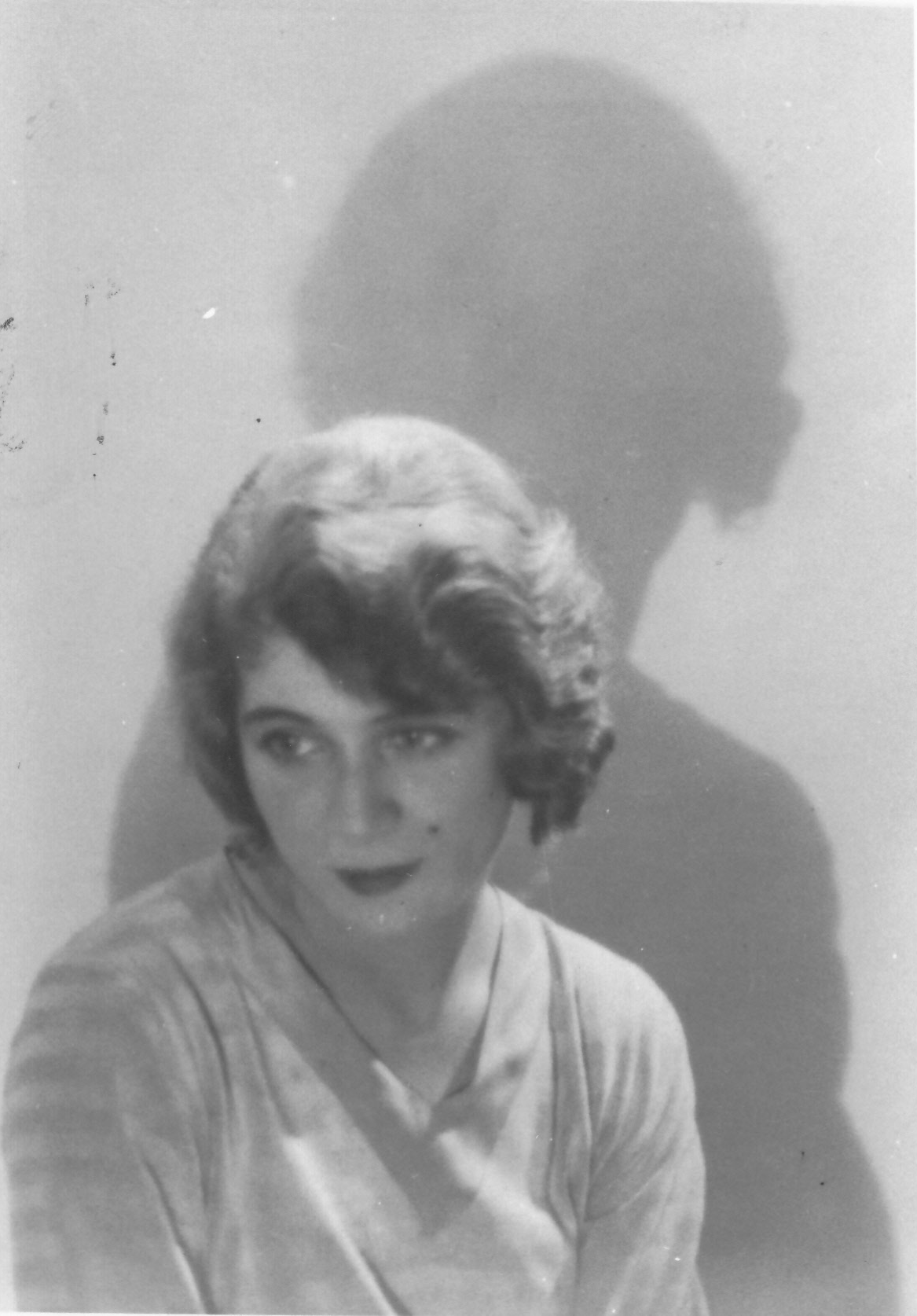
1907–1913 André Breton student at Collège Chaptal (Paris)
October 2, 1907 – Entry to Collège Chaptal, 45, boulevard des Batignolles, directly in 5th grade class. At the time, the city of Paris manages five secondary education establishments, of modern character (without Latin or Greek) called "colleges" to differentiate them from state high schools.
AB is there for 6 years as a half-boarder, from 8 AM to 4:30 PM.
"Round trip journey in third grade taking place at the reminder of the next day's lesson or the great blue traps of the day." (I, 59)
He writes that he takes the train from Pantin to the Batignolles station. As Julien Barret shows: https://autour-de-paris.com/project/enquete-poetique-sur-les-pas-andre-breton-pantin, he more likely takes several public transports accessible throughout his schooling: the train then the metro...
At 12 or 13 years old His parents reward him with a small sum with which he buys himself a first fetish (object from Easter Island), mentioned in Nadja: "from Easter Island, which is the first savage object I possessed, saying to him: 'I love you, I love you.'" (OC I, 727).
1910
July. at the end of the 3rd grade year, the director of the College's appreciation on his school record: "This student's zeal has been maintained until the end of the school year. Several good rankings have rewarded his efforts".
Spends vacations in Germany. He discovers the Black Forest, improves his practice of the language (every day a two-hour course).
1910-1911 2nd grade D class
"It is by the way of reciting The Young Captive that I choose my first friend." (OC I, 59) This is Théodore Fraenkel (1896-1954), see his Notebooks 1916-1918. He is his junior by 2 months and finds himself then in the same section. Brilliant but slacker student, often confined. He will follow medical studies like AB, and they will be very close until 1930. He will end his career as a neighborhood doctor, after having been head of service at the public hospital. Secret poet, he was also an artist through his collages and sculptures. Gérard Guégan devoted a passionate biography to him.
In second grade, AB deplores the extreme classicism of his French teacher. He is seduced by Alfred de Vigny, whose The Shepherd's House and Stello of which he will write: "from reading Stello in my youth, the affective memory that alone survives persists in making me value, specifically, a tragic and distant feeling of life, of which I see poorly how one could contest the nobility." (see his variations on Vigny
1911
The city of Paris grants him a half-board scholarship.
In 1st grade class, it is a substitute literature teacher, Albert Keim (1876-1947), doctor of letters with a thesis on Helvétius, and himself a poet (A poem of soul.), who makes him know Baudelaire, Mallarmé, Huysmans, the symbolists.
AB writes his first poem, "Dream" (OC I, 29). The second, Eden, is dedicated to his literature teacher (OC I, 30).
First poems published under the anagrammatic pseudonym of René Dobrant, in a school newspaper, Towards the Ideal, animated by René Hilsum (1895-1999). Precocious, the latter animated a socialist grouping, "The Guild towards the Ideal", to train future militants. "He would do well to give up studies or foreign concerns that divert him from them." notes the director of Chaptal at the end of the year. Excluded from the college, this did not prevent him from frequenting Fraenkel and AB, to whom he procured magazines, and from animating, two years later, a movement against the military obligation extended to 3 years! We will see him again soon with his two friends in the Dada movement.
1912-1913 philosophy class
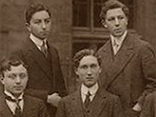
Detail of a collective class photo AAB: André Breton class photograph (andrebreton.fr)
He finds Théodore Fraenkel there again. Their philosophy teacher, André Cresson (1869-1950) has just been appointed to Chaptal. Admirer of Kant (on whom he defended his doctoral thesis), he is far from Hegel whose work AB "senses" through the master's sarcasms. His notebook of notes reflects this. In the third quarter, it is judged that he must acquire "mental maturity" while Fraenkel is qualified as an "intelligent student who worked very well in philosophy and showed excellent aptitudes there"
Attracted by contemporary painting. The Sunday walks with his parents, from the Gare de l'Est to the Madeleine church, lead him to stop in front of the Bernheim-Jeune Gallery:
"The only outlet that these walks presented for me is that I obtained to enter for a few minutes to the Bernheim Gallery, where perhaps one or two Matisse were exhibited. […] The exhibited canvases were not changed very often but no matter if it was The Joy of Life for example, the joy of life I believe I took it there." he writes to Matisse on February 5, 1948 (Matisse Archives, AB convulsive beauty, p. 86).
Revelation of beauty at the Gustave Moreau museum. "It has conditioned forever (his) way of loving" (IV, 785).
March 28, 1913 During the Easter holidays, visits the Salon des Indépendants, galleries, the Luxembourg museum. Admires Bonnard, Vuillard, K. X. Roussel, Signac, doubts the value and sincerity of cubist and futurist canvases (letter to T. Fraenkel, in Marguerite Bonnet, André Breton, birth of the surrealist adventure, Corti, 1975, p. 34).
Same period: composes poems and reads Albert Samain, Henri de Régnier, Maeterlinck, Mallarmé, whose "bearing" he admires. Considers The Lady with the Scythe by Saint-Pol Roux, as masterpiece of symbolist theater (OC III, 429 sq.)
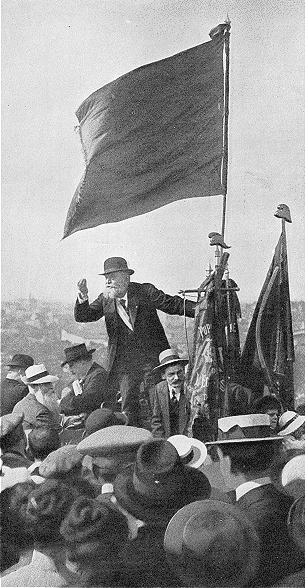
Sunday May 25, 1913: Demonstration at Pré-Saint-Gervais, Jaurès' speech (SFIO) against the law extending military service to 3 years. AB participates with his father. "The red flag, pure of marks and insignia, I will always find for it the eye that I could have at seventeen, when, during a popular demonstration, on the approach of the other war, I saw it deployed by thousands in the low sky of Pré Saint–Gervais. And yet – I feel that by reason I can do nothing about it – I will continue to tremble even more at the evocation of the moment when this flaming sea, in few and well-circumscribed places, was pierced by the flight of black flags." (Arcane 17, OC III, 41).
June 30, 1913: AB obtains the baccalaureate. Summer vacation in Lorient.
August 1913. Numerous readings. Discovers Villiers de l'Isle Adam, Péladan, Jean Lorrain, appreciates the truth of the first Huysmans, detests Maupassant, judges Maurice Barrès "of very great depth and often admirable philosophy, at the same time as integral symbolism…" In poetry, he still admires Saint-Pol Roux, Francis Viélé-Griffin, René Ghil, Jean Royère, Apollinaire. Does not "get excited about Marinetti's futurism…" (letter to T. Fraenkel, in Bonnet, ibid. p. 27).
In 1965, AB refuses to return to his school past: (letter from a Chaptal teacher), An examination room at the Chaptal high school now bears his name.
October 1913 Enrolled at the Faculty of Sciences (Sorbonne) to prepare for the PCN (certificate of physical, chemical, natural studies). Student card n° 294. Finds Fraenkel, Hilsum there again.
To the journalist who asks him, in 1952, to speak about the determinants of his youth, AB answers: "I am forced, to answer you, to consider myself much later, let's say at the end of adolescence, that is to say at the moment when I already know myself a certain number of tastes and resistances well of my own. This moment can be fixed at 1913." (OC III, 428)
1914
Follows courses and practical work assiduously, but his mind is elsewhere. Frequents poetic matinees, tears himself away from literary magazines, learns Valéry's poems by heart, fascinated by the poet's silence for fifteen years.
March 7 [1914] AB writes to Valéry that M. Teste is "one of the most incontestable masterpieces of symbolism".
March 15, 1914: Paul Valéry welcomes him to his home and observes him "with a very blue transparent of withdrawn sea" (OC III, 434). AB submits to him the poem "Laughing" and confides to him that he seeks in poetry "a physical trouble characterized by the sensation of a wind aigrette at the temples" (OC II, 678). An intimate and trusting relationship between them extends until 1925. March 1914, La Phalange (dir. Jean Royère) publishes 3 poems by AB.
June 1914: AB in Lorient at his parents' revises for the PCN exam which he fails. August 3, 1914: Germany's declaration of war on France. General mobilization.
"the news of Jaurès' assassination [July 31] has very painfully moved me, more perhaps than the eventual declaration of war could do" (AB to TF, M. Bonnet, AB…, p. 65.)
Dated August 1914, the poem "Hymn" (OC I, 8) reflects his state of mind regarding the conflict. Under the influence of Rimbaud: A Season in Hell, "masterpiece of perversity".
September 24: obtains the PCN.
September 29: enrolls at the Paris Faculty of Medicine.
Classes resume as if there were no war. AB follows them regularly, learns anatomy lessons by heart. Lives with his parents, 70, route d'Aubervilliers in Pantin (today avenue Édouard-Vaillant).