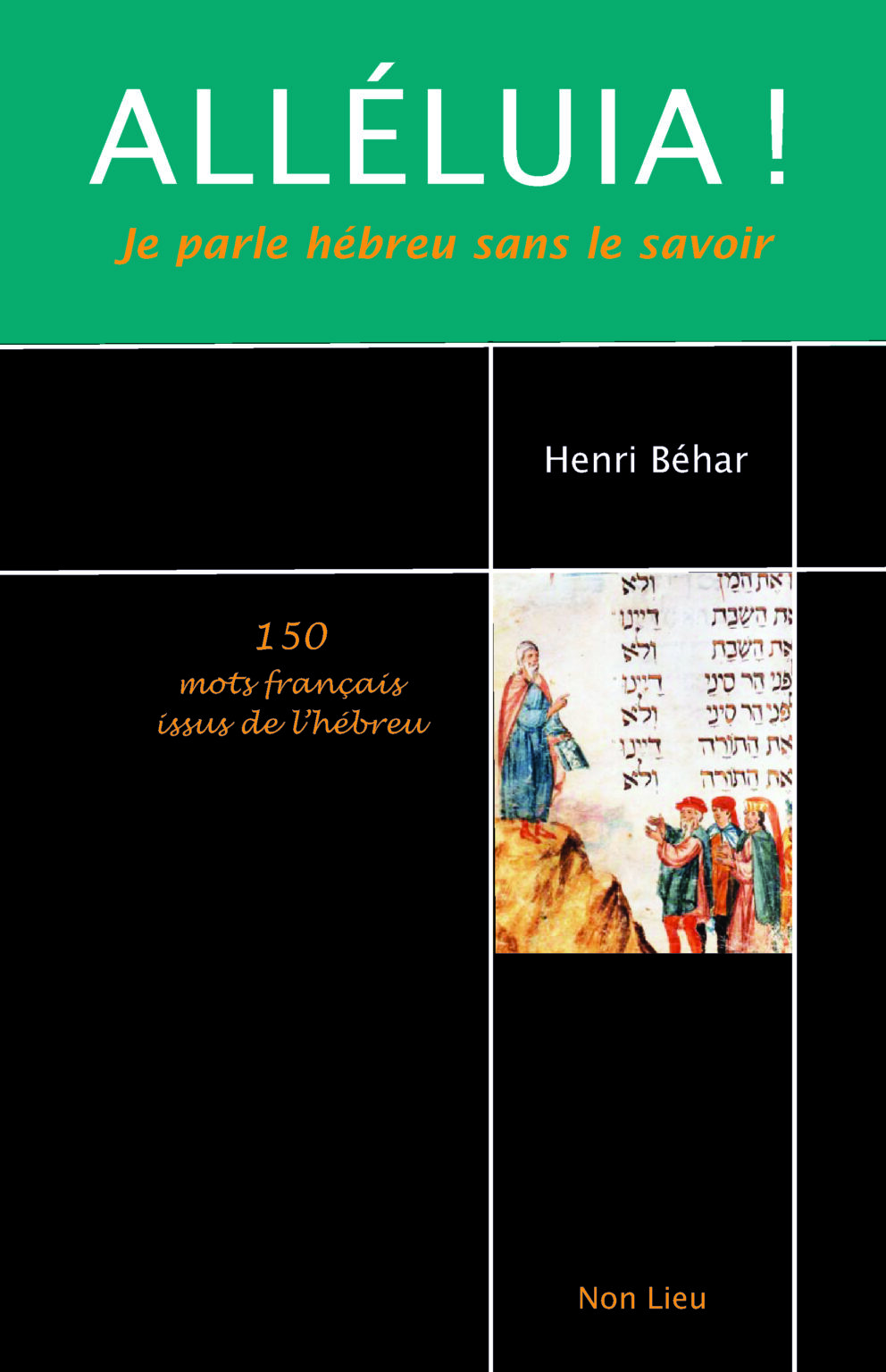
HALLELUJAH!
I speak Hebrew without knowing it
150 French words from Hebrew
Henri Béhar
One can estimate at a thousand the French terms coming from Hebrew, which are immediately divided into two categories: terms borrowed from the sacred language through the religious path, and others, coming from the commerce of spirits and social relations.
It is not surprising to regularly hear Christians pronounce amen or even hallelujah without knowing that the Church has voluntarily maintained these Hebrew words in prayers to mark the origins of this religion.
Henri Béhar wonders why the French language, so rich, feels the need to acquire certain vocabulary, and to preserve it in its capital over time, while constantly renewing the operation. (Thus the charming cherub or even the very popular shallot.) In his dictionary, Henri Béhar has retained only words, on the one hand belonging to ancient Hebrew, from the time of the Bible, on the other hand for some relating to modern Hebrew, or even Yiddish. Judging it irritating to hear political leaders and elected officials declare that French is a unitary language, coming entirely from Latin, without other contributions, he chose to note 150 words of Hebrew etymology and to study their formation, history and usage in our literature and our culture. It's little, one will say, but it's enough to dismantle the mechanism of borrowing, to which our language indulges with pleasure.
The author: Henri Béhar, former president of the University Paris III-Sorbonne Nouvelle, is a specialist in avant-garde literatures and a pioneer in the use of computer science in literary studies. At Non Lieu editions, he has already published: At table with Albert Cohen.
ISBN: 978-2-35270-310-5 Price: 18 € Non Lieu Editions 224, rue des Pyrénées – 75020 Paris email: nonlieu@netcourrier.com www.editionsnonlieu.fr
Review by Anne Szulmajster-Celnikier in the journal La Linguistique 2022/2 (Vol. 58), pages 199 to 211 About Hallelujah. I speak Hebrew without knowing it, 150 French words from Hebrew, by Henri Béhar.
1. The problematic
The theme of borrowings from Hebrew in French punctuates publications, old and new, sometimes taking the form of dictionaries, sometimes chapters within volumes devoted to the French language and its history, or even books or articles examining, in a targeted manner or not, Hebrew borrowings or borrowings from various sources in our language. Let us mention in particular: Patrick Jean-Baptiste prefaced by Claude Hagège, Dictionary of French words from Hebrew (2010); the section "French words of Hebrew origin, History of French", chapter 10 "Borrowings and the French language" (Lionel Jean revision), Wiktionary; Henriette Walter, The adventure of French words from elsewhere (1997); and finally Michel Masson, "Etymological legends: about some French words reputed to come from Hebrew" (2012).
2. Author profile
The striking title, tinged with humor, of the new book signed by Henri Béhar announces an unconventional approach. Neither quite a dictionary in the classical sense, nor an encyclopedia despite some passages, it is a free, rich and original form that presents itself here to the reader. One recognizes there the mark of the author, a personality with varied facets. [read more by downloading the PDF of this review]